Rebar tying and welding robots
Rebar, welding & assembly buyer’s guide
Robots that tie rebar, weld pipe spools and assemble structural parts.
What these robots do
They take over slow, repetitive work: tying rebar on site and welding pipes and steel parts.
Rebar is the steel bars inside concrete. Workers lay the bars in a grid, called a mat, and tie each crossing with wire so the bars stay in place.
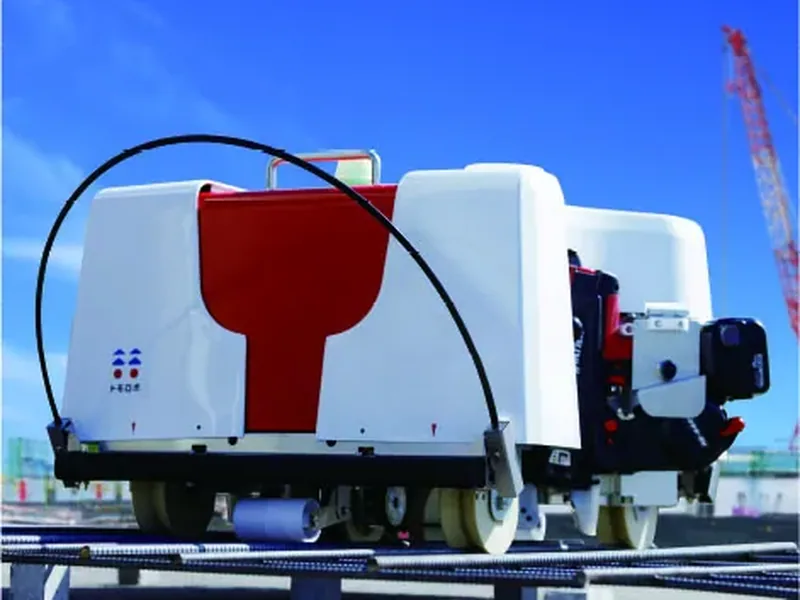
A rebar robot rides on the mat or on rails beside it. Its sensors find each crossing and it ties it, while a worker watches and refills the wire.
Welding robots mostly work in fabrication shops, which are workshops where steel parts are made. They weld pipes and steel parts that people used to weld by hand.
Some welding robots also work in the field, for example on pipelines or on steel columns at a building site.
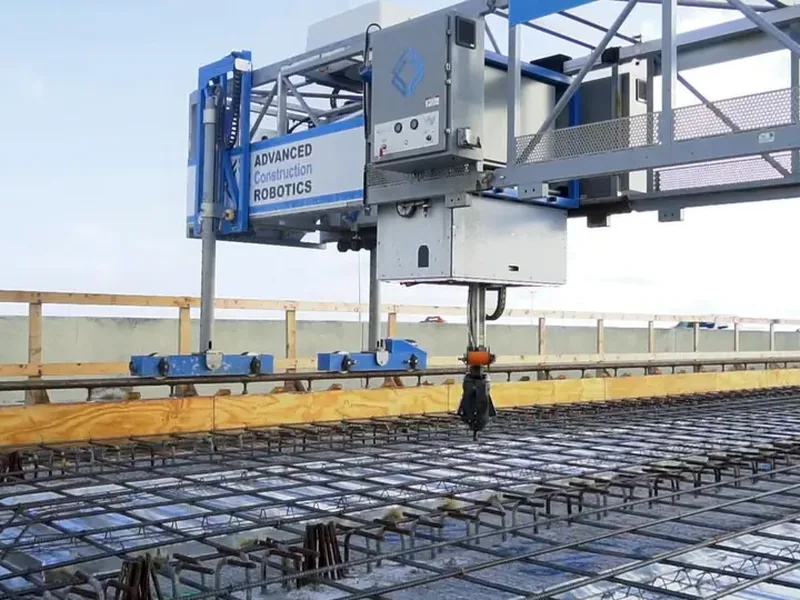
TyBOT
Gantry robot running on screed rails/edge forms that autonomously finds and ties rebar intersections on bridge…
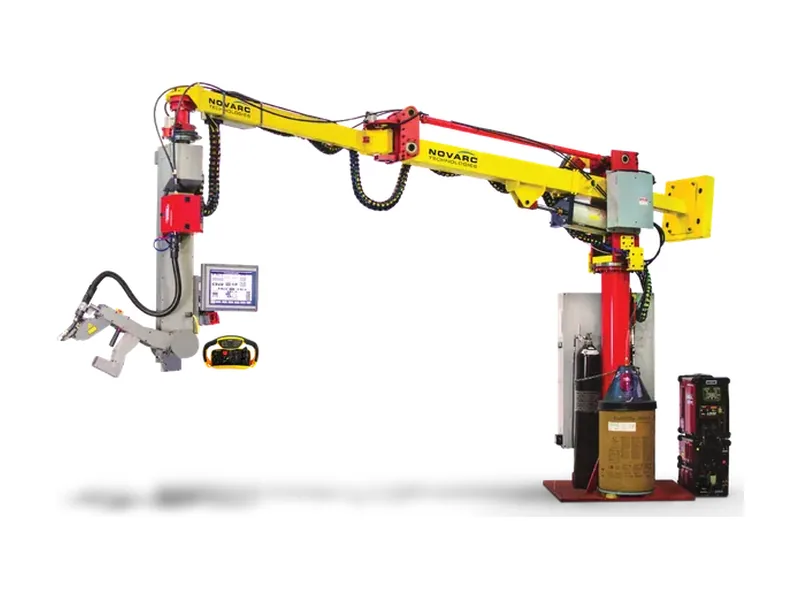
SWR - MIG / SWR+HyperFill
Collaborative pipe-spool welding robot for MEP/industrial prefabrication shops, with AI seam tracking (NovAI)
What they cost
No maker publishes a price, so you have to ask for a quote.
None of the 22 robots in our catalogue has a published price. For every model, you have to contact the maker.
When you ask, get the full cost. That means the robot, delivery, setup, training, spare parts and service. Ask if you can rent or lease it, and if an operator comes with it.
Compare the price with the work it saves. Count how many ties or metres of weld your crews do each year, and how many hours that takes.
The main kinds
Pick the kind that matches your work: tying on site, preparing bars, or welding.
The catalogue lists 22 robots from 13 makers. They fall into four groups.
Rebar tying on site
Small robots drive on top of the mat and tie each crossing. One small model weighs 39 kg, so a worker can move it between jobs.
Larger robots use a gantry. A gantry is a frame that spans the whole deck and moves along screed rails. Screed rails are the rails at the edges that guide the concrete levelling machine. One gantry base unit weighs 1,864 kg.
Rebar placing and processing
Some machines lift bundles of bars and place them on a bridge deck. Others work in a yard or factory, where they cut bars to length, move them on conveyors, or check their shape with cameras.
Welding in the shop
Pipe spool robots weld spools, which are pipe sections made in the shop before they go to the building or plant. Seam tracking means a sensor follows the joint so the weld stays on the line.
Portable welding platforms can be moved by crane or forklift to big parts like tanks and tower sections.
Welding in the field
Pipeline systems weld joints along the line. Some work from inside the pipe and weld the root pass, the first layer at the bottom of the joint.
Other robots weld steel columns on building sites, or travel on rails over ship sections.
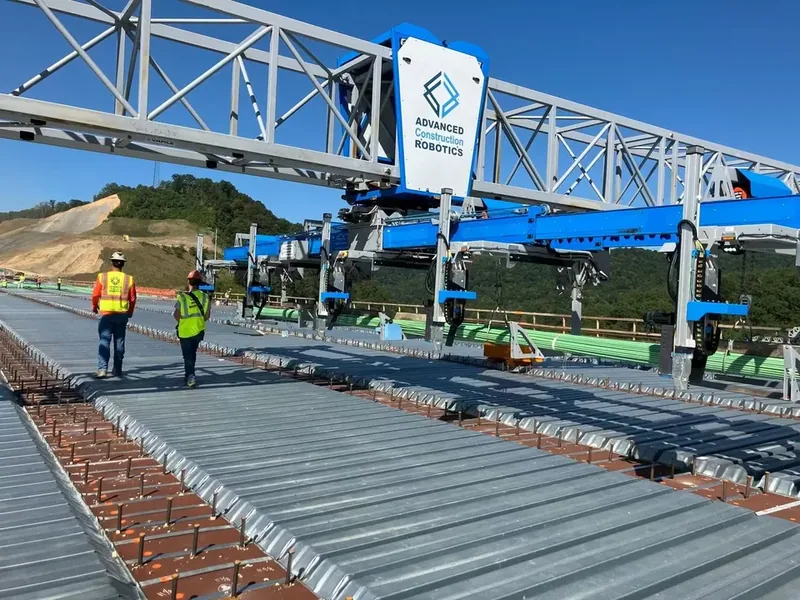
IronBOT
Gantry robot that lifts, carries, singulates and places transverse and longitudinal rebar bundles on decks
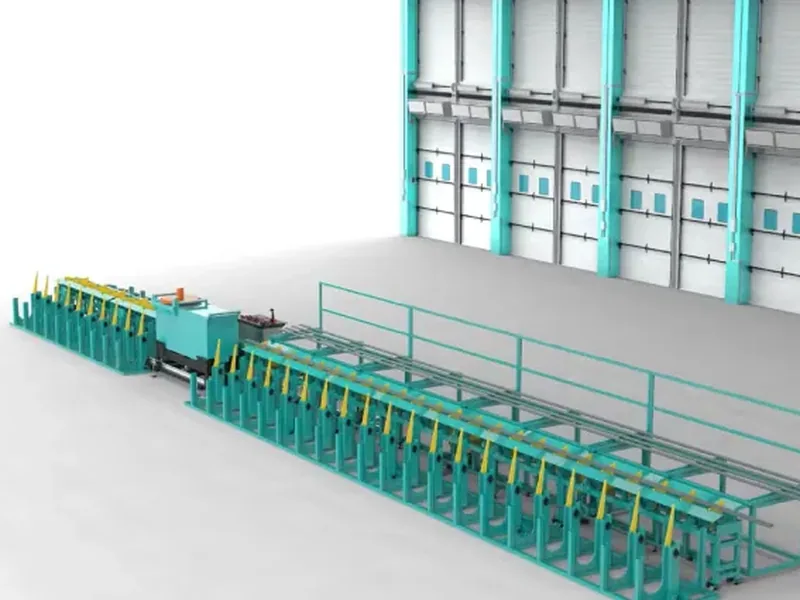
Smart Rebar Processing Line
Automated rebar cutting and conveying line with 1 mm accuracy.
How to size it for your job
Match the work rate, width and bar or pipe size to your real jobs.
For tying, look at ties per hour. One small mat robot lists 500–700 nodes per hour (a node is a crossing). One deck gantry reports 1,200+ ties per hour on real jobs.
For gantry robots, check the width they can span. One deck robot lists a screed rail width of 10-117 ft. Check bar size too: one maker sells a separate model for large-diameter bars.
For welding, check pipe diameters and welding processes. One spool robot lists pipes of 2-60 in (50-1,520 mm).
Also check setup time per job. This matters most if you have many small jobs. One placing robot says it is on site and working within 6-8 h.
What to check before you buy
Check where it works, what it needs from you, and who repairs it.
On site or in a shop makes a big difference. Site robots must handle weather, dust and uneven ground. One small tying robot lists a maximum slope of 15°.
Welding robots must also meet the weld rules your clients ask for. Ask if the maker helps with weld tests and paperwork.
- Power: battery size and charge time, or a mains supply such as 7 kW 240 VAC for a large gantry
- Supplies: tie wire, welding wire and gas, and which tools the robot uses
- Service: local technicians, spare parts and training for your crew
- Safety: who must stay near the robot, and how it stops when a person is in the way
How ready they are
Most are on sale, but some are still being tested.
17 of the 22 robots in our catalogue are on sale now. Two are in pilot use, one is a prototype, and two have no clear stage.
Pilot means it works on real jobs with the maker's help. A prototype is an early test machine. Robots with no clear stage may not be for sale at all.
Ask for references and a visit to a working site before you plan a job around a new robot.
Which one is for me?
- Bridge or road deck contractor: Look at gantry robots that run on the screed rails. Check the span width, ties per hour and setup time.
- Building contractor with flat slabs and floors: A light robot that rides on the mat is easy to move between floors. Check battery time, slope limit and the bar spacing it can handle. For example RBTS1 Rebar Tying Robot.
- Pipe spool shop (plumbing, heating, process pipe): Look at spool welding robots with seam tracking. Check pipe sizes, welding processes and the floor space it needs.
- Pipeline contractor: Look at systems that weld in the field, inside or around the pipe. Check pipe diameters and how fast each joint is done. For example Internal Welding Machine (IWM).
- Heavy steel fabricator (tanks, towers, ships): Look at portable platforms or crawlers that go to the part. Check reach, welding positions and how the robot is moved. For example ArcPod.
Compare all 22 models in the catalogue by work rate, size and stage. Then ask two or three makers for a quote and a site visit.