Material handling robots for construction
Lifting & material handling buyer’s guide
Robots that lift and move materials on site: pallets, boards, blocks and tools.
What these robots do
They carry or hold the heavy load, so your workers lift less.
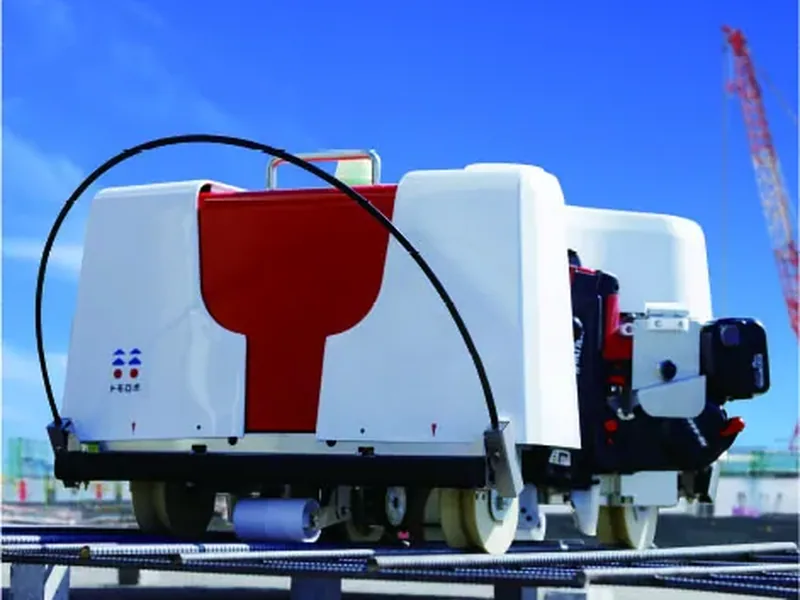
These robots lift and move materials on a site: pallets, boards, blocks, glass, scaffolding and tools.
Some carry loads along floors, up stairs or over rough ground. Others hold the weight of a block or panel while a worker guides it into place by hand.
The aim is simple: fewer injuries from heavy lifting, and less waiting for a crane or forklift.
Our catalogue lists 20 of these robots from 18 makers. 16 of them are on sale now. The others are pilots (tested on real sites but not yet sold widely), prototypes, or of unknown stage.
How much they cost
Most makers give prices only on request, so ask for a full quote.
2 of the 20 robots in our catalogue have a published price. Both are lift-assist arms, and both start from $1,465 per month.
A monthly price usually means you rent or lease the robot instead of buying it. This can suit a contractor who needs it for a few months only.
For all other models you must ask the maker. Ask what the price includes: delivery, training, service, spare batteries and software.
Compare the cost with what you pay now for cranes, hire machines or extra workers.
The main kinds
Pick the kind that matches how the load must move: along, up or into place.
The robots in this group work in quite different ways. These are the main kinds.
Tracked carriers
A tracked carrier runs on rubber tracks, like a small digger. Tracks grip well on mud, gravel and stairs.
Some are self-levelling: they keep the load flat on a slope. One in the catalogue carries up to 3,000 kg and works on slopes up to 20°.
Lift-assist arms
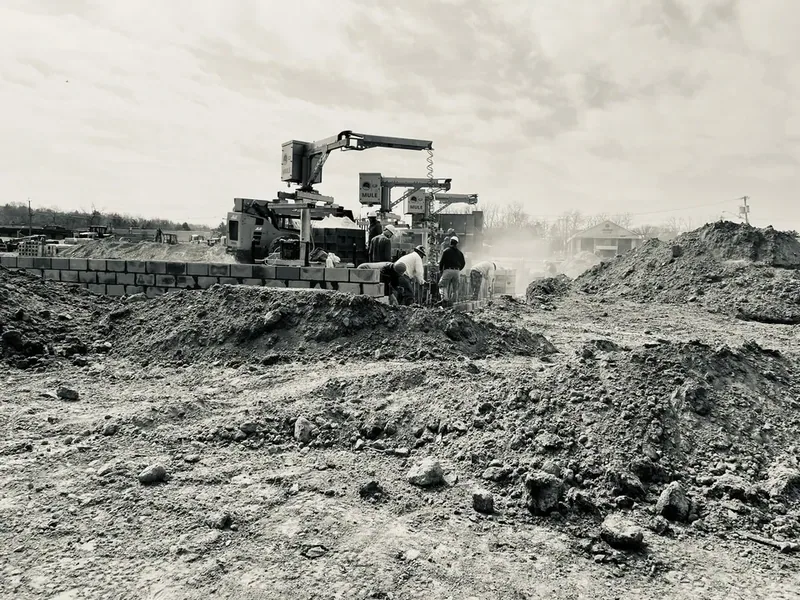
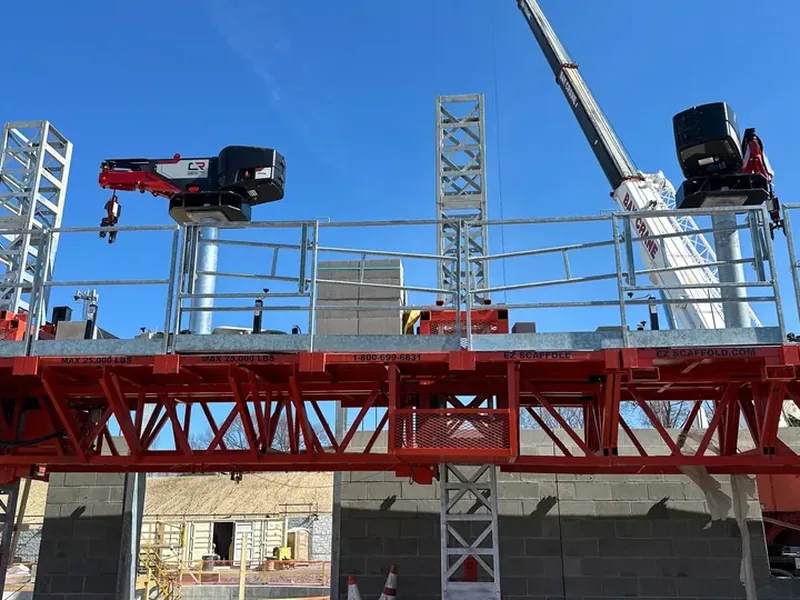
A lift-assist arm holds the weight of a heavy block or panel. The worker still guides and places it by hand.
Models in the catalogue carry from 45 kg (100 lb) up to 200 lb. They hold the load with clamps or vacuum grippers (suction pads).
Hoists and gantries
A hoist lifts loads straight up, for example up a scaffold on a rail.
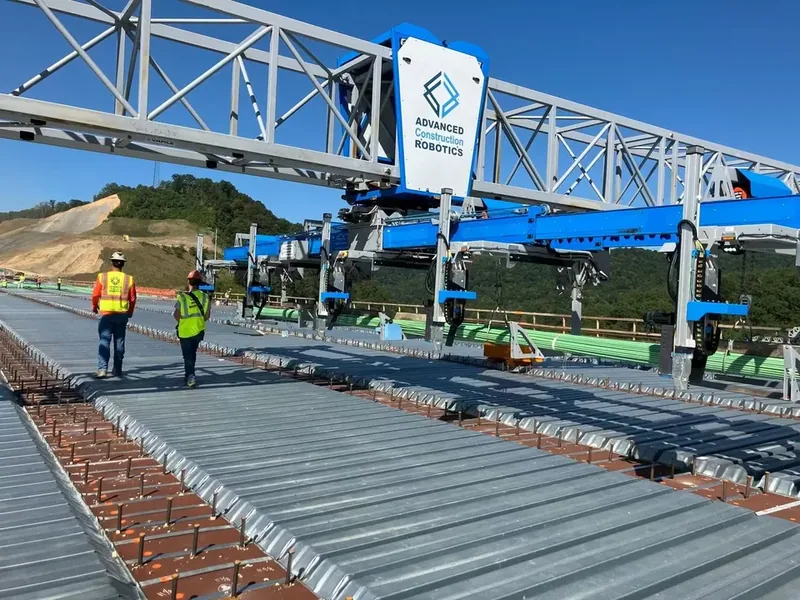
A gantry is a frame that spans the work area and lifts from above. A gantry robot in the catalogue places rebar (steel bars for concrete) at an average of 5,000 lb (about 2,270 kg) per hour.
Glazing robots
These wheeled robots lift, turn and tilt glass panes with suction pads, so installers do not carry the glass.
Kits for machines you own
Some makers sell a retrofit kit. Retrofit means you add it to a machine you already have, such as an excavator, wheel loader or forklift.
The kit lets the machine do repeated work on its own while a person supervises.
How to size it for your job
Start from your heaviest load and the highest or farthest place it must go.
Write down the heaviest single item you move, such as a block, a glass pane or a pallet. Then add a safety margin.
Payload means the most weight the robot can carry or hold. Check it at the reach you need, because many arms lift less when stretched out. A glazing robot in the catalogue lifts up to 600 kg close in, but 300 kg with the arm fully extended and 200 kg overhead.
Reach means how far the arm can move a load from its base. A block-laying arm in the catalogue reaches a radius of 3.65 m.
For bigger jobs, think in weight per shift. A scaffold hoist in the catalogue moves about 6,000 kg in an 8-hour shift with three people.
What to check before you buy
Check it fits your doors and stairs, and that the battery lasts a full shift.
Measure doors, corridors, lifts and stairs on your site. Compare them with the robot's size when folded or packed for transport.
Weight matters too. A tracked robot arm in the catalogue is under 800 mm wide for transport and weighs under 1,300 kg, so check that floors and ramps can carry it.
Battery runtime is how long the robot works on one charge. A hoist in the catalogue runs 8-10 hours, charges in 2-3 hours and has swappable batteries, so you can change the battery and keep working.
- Payload at the reach and height you need
- Width and weight for doors, stairs and floors
- Battery runtime, charge time and spare batteries
- Service: who repairs it, and how fast
Safety, rules and connection
A robot that lifts is still lifting equipment: train people and follow local rules.
In many countries, lifting equipment needs regular checks by a qualified person. Ask your supplier which rules apply where you work.
Train every worker who uses the robot. Keep people out from under a lifted load, and make sure the emergency stop is easy to reach.
Some robots are called collaborative. This means they are designed to work close to people, but you still need clear site rules.
Kits that make excavators or loaders work on their own need a person to supervise. Ask how the kit connects: one uses long-range Wi-Fi and can also work offline. Also check it fits your machine; one needs electro-hydraulic pilot valves (electric controls for the hydraulics).
Which one is for me?
- Masonry or block-wall contractor: Look at lift-assist arms. Check that the payload covers your heaviest block, and ask about monthly rental if the work is seasonal.
- Fit-out or renovation contractor working inside buildings: Look for a compact carrier that fits through your doors and on your stairs. Check that the battery lasts a full shift.
- Earthworks contractor with excavators or wheel loaders: A retrofit kit may suit you better than a new machine. Check it fits your brand and size: one kit works on machines from 10 to 100+ t. For example Gravis RACK.
- Farm or facility moving heavy loads over rough or sloping ground: Look at tracked carriers. Compare payload and maximum slope; some carry up to 3,000 kg. For example AlmaCrawler Multiloader BL 3.0.
- Potato or vegetable farm with many crates: The catalogue also lists a crate-washing robot that works from a forklift and washes up to 40 crates per hour. Its stage is unknown, so ask the maker if it is on sale.
Compare payload, reach, size and battery runtime across all 20 models in our catalogue. Then ask several makers for a full quote.