Solar panel installation robots
Solar panel installation robot buyer’s guide
Robots that help build solar farms: placing and fixing modules, distributing piles and assembling tables.
What these robots do
They do the heavy, repeated work of building a solar farm, so the crew lifts less.
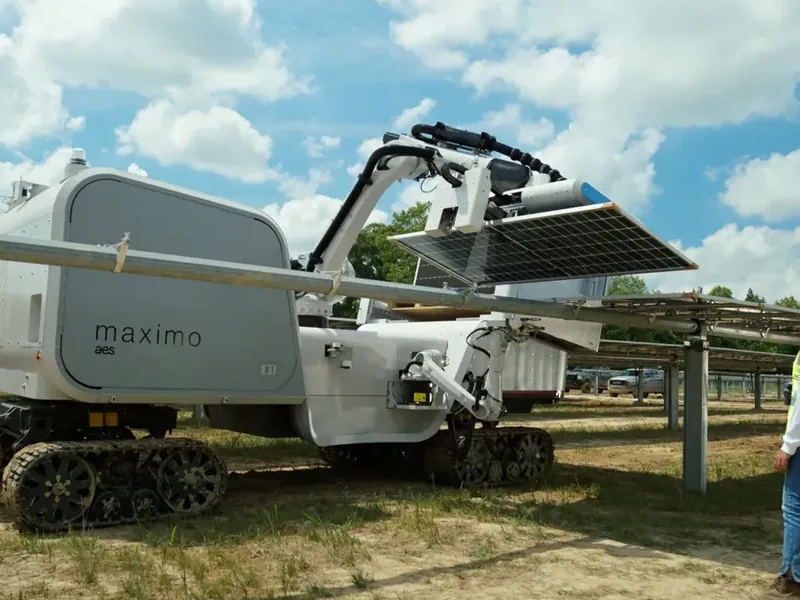
These robots help build large solar farms on open ground. Most of them carry solar panels (also called modules) along the rows and place each one on its frame.
The frame is often a tracker. A tracker is a steel structure that slowly turns the panels to follow the sun. The panels sit on a long steel bar called a torque tube.
Other robots work earlier in the job. They carry and drive piles, the steel posts pushed into the ground that hold up the frames.
Our catalogue lists 17 robots from 13 makers. Seven of them are on sale today. Most of the others are still in pilot projects, which means they are tested on real sites but not yet sold widely.
How much they cost
No maker publishes a price, so you must ask for a quote.
None of the 17 robots in our catalogue has a published price. Every maker asks you to contact them.
When you ask, find out what you are paying for. You may be able to buy the robot, rent it, or pay the maker to do part of the installation for you.
Also ask about the costs around the robot. These include transport to site, setup, training, spare parts, software and the people the maker sends to help.
The main kinds
Choose by the stage of the build: piles, panel placing, or a full field factory.
The robots fall into a few groups. Each group does a different part of building a solar farm.
Pile robots
These robots spread piles across the site, carry them to each spot and drive them into the ground. Some use a separate robot to measure the position so each pile is placed exactly.
One maker says its piles end up within 1.0° of plumb (straight up and down) and within 15 mm of the planned height.
Panel-placing robots
These are vehicles that drive along the row with a stack of panels. An arm picks each panel and puts it on the tracker, often using cameras to line it up.
Some also tighten the clamps that hold the panel. People usually still bring the panels to the robot with a loader or telehandler (a lifting vehicle with a long arm).
Field factories
A field factory is a small assembly line set up on the construction site. It joins the steel frame and the panels into finished sections, called tables or bays, and then delivers them to the rows.
These need a flat working area and a team to run them, but they move much of the work into one place.
Delivery robots
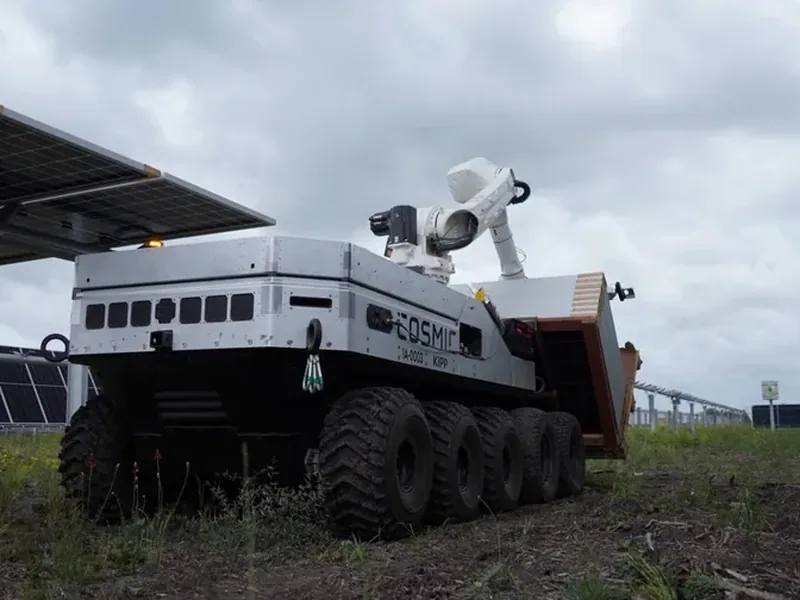
Some systems only move material. They drive panels, pallets or steel parts around the site so the crew does not have to.
How to size it for your job
Compare the robot's real output with your site size, your schedule and the crew you have.
Start with the number of panels you must install and the days you have. Then compare that with what the robot can really do.
Makers publish figures in different ways. One placing robot is listed at up to 90 modules an hour. One field factory is listed at 850-1,000 modules a day, or 0.5-1 MW (megawatts, a measure of solar power) per shift.
Ask how many robots work together as a fleet, and how many hours a day they can run. Ask also how long setup and teardown take, because this matters more on smaller sites.
- Panels or piles per hour and per day
- How many robots you need at the same time
- Days needed to set up and move the system
What to check before you buy
Check tracker fit, crew size, safety and ground conditions before you sign.
Ask which tracker and frame systems the robot supports. Check if it handles fixed frames, panels turned long side up or long side across, and different torque-tube heights.
Ask how many people are still needed. One maker says its robot runs with a crew of two people plus a vehicle that feeds the panels.
Check safety. Good systems use lidar (a laser that measures distance) and cameras to see people and stop the machine.
Check your site. Ask about slopes, mud, wind and heat limits, and how the robot is charged or powered in the field.
- Supported trackers and panel sizes
- Crew size still needed
- People detection and stop systems
- Weather, slope and power limits
Pilot stage and support
Many of these robots are new, so ask for real site results and local service.
This is a young field. Five robots in our catalogue are still in pilot stage, and one programme has already stopped.
Ask the maker for results from finished sites, not only test days. Ask who fixes the robot if it breaks during your project, and how fast they can reach you.
Ask about the planning software too. Some makers plan the robot's work with their own software, so check that it works with your site drawings.
Which one is for me?
- Large contractor building many big solar farms: Look at field factories and fleets of panel-placing robots. Compare output per shift, setup time and how many sites the system can move between.
- Installer with its own module crews: Look at panel-placing robots that work beside your crew. Check which trackers they support and how many people are still needed to feed them panels.
- Piling or civil works contractor: Look at pile-driving and pile-distribution robots. Check how many piles they carry, which pile sizes they take and how exact the placement is.
- Solar farm owner or developer: You may not buy a robot yourself. Ask your builder which robots they use, what stage those robots are at and what results they had on other sites.
- Farm or business with a small solar field: These robots are made for large solar farms. For a small field, a normal manual crew is usually simpler, so check whether a robot really saves time first.
Compare all 17 solar panel installation robots in our catalogue to see what each one does, its stage and its published specs. Then contact the makers on your shortlist for a quote.