Milking robot buyer’s guide
Milking robots let cows come to be milked when they want, day and night, without a fixed milking time.
What a milking robot does
The cow decides when to be milked. The robot does the work in the box.
A milking robot lets cows come to be milked when they want, day and night. There is no fixed milking time.
The cow walks into a box, often because she gets some feed there. A robot arm finds the teats with cameras or lasers, cleans them and attaches the cups.
While milking, the robot checks the milk from each quarter. A quarter is one of the four parts of the udder, each with its own teat.
Our catalogue lists 17 milking robots from 8 makers. 14 of them are on sale now.
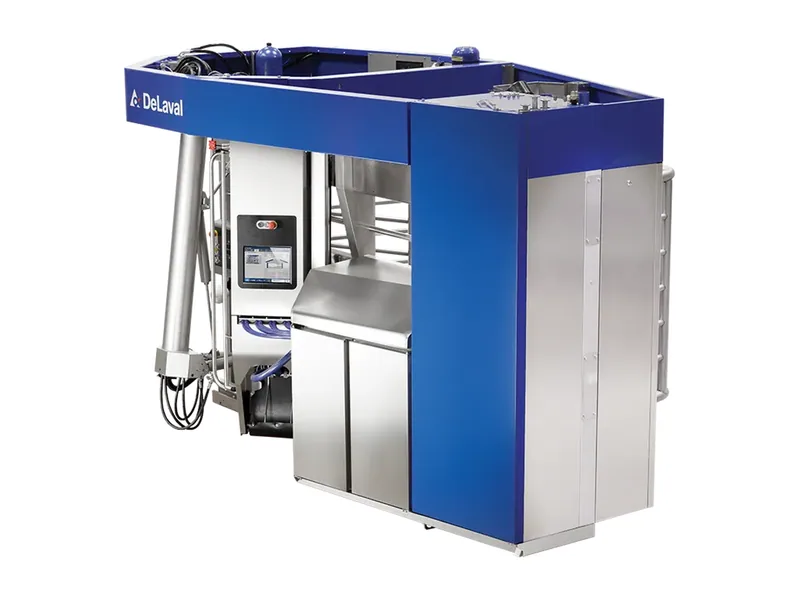
DeLaval VMS V300
Voluntary single-box milking robot
About €145,000
Lely Astronaut A5 Next
Voluntary single-box milking robot with hybrid arm, brush teat cleaning, I-Flow concept
The main kinds
Choose the kind that fits your barn and your herd size.
Milking robots are not all the same box. Some move the cow to the robot, some move the robot to the cow, and some help in a parlour you already have.
Single box
One robot arm serves one milking box. Cows come in freely, one at a time.
You add more boxes as the herd grows.
Double box
One arm serves two stalls side by side. BouMatic says its Gemini UP can milk two cows at the same time this way, attaching the cups from behind, between the rear legs.
Batch milking
Several robots stand together, and cows are brought in groups at set times. It works like a parlour, which is a fixed milking room where people normally attach the cups.
DeLaval, GEA and BouMatic offer this set-up for larger herds.
Robotic rotary
Cows stand on a slowly turning platform, and a robot attaches the cups as they pass. GEA DairyProQ is made for large herds.
Robots for tie-stall barns
In a tie-stall barn, each cow stays in her own place. Here the robot comes to the cow: it runs on a rail along the alley.
ORION CarryRobo carries the milking units along the barn so one person can milk. Milkomax Roboleo milks the cows on a schedule.
Help in an existing parlour
Some robots do part of the work in a parlour you already have. DeLaval TSR sprays teats on a rotary parlour.
Afimilk Synergy prepares teats, attaches cups and cleans inside a parallel parlour, where cows stand side by side.
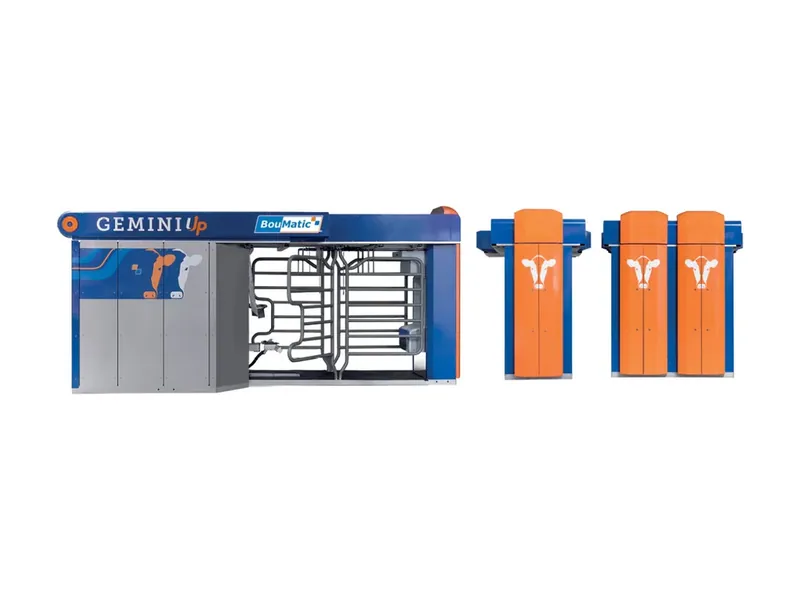
BouMatic Gemini UP
Milking robot attaching from behind; single box or double box where one arm serves two stalls
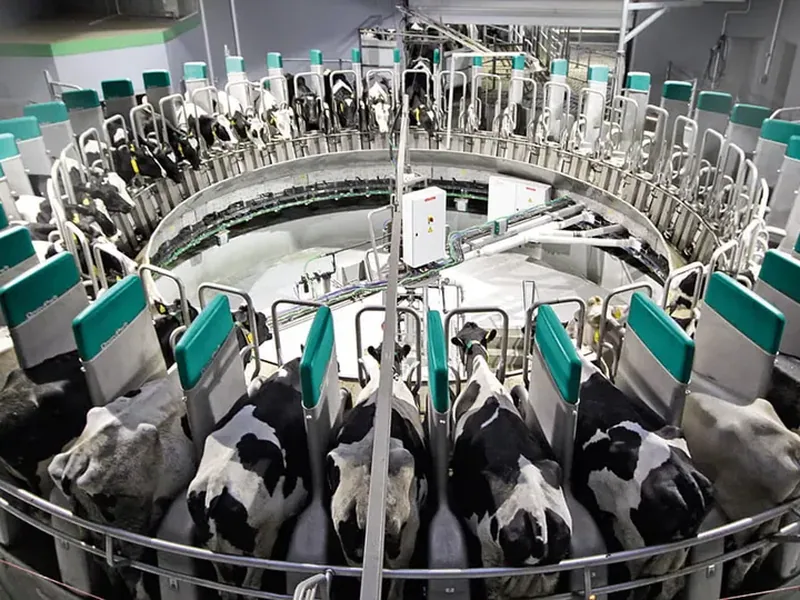
GEA DairyProQ
Robotic rotary milking for large herds
How much it costs
Plan for about €150,000 to €176,000 per box, plus about €7,000 a year for service and repairs.
Makers almost never publish prices. Farm advisers and the farm press give these figures:
- Price of one box: top agrar says €150,000 and more. The Lower Austria chamber of agriculture budgets €176,000, without milk storage and cooling. Utah State University used US$190,000 per robot.
- Service and repairs: farms in Bavaria paid about €7,000 per box a year on average, from €3,000 to €10,000. A service contract alone costs about €3,000 to €5,000.
- Power and water: in the DLG test, a Lely Astronaut A5 used 1.62 kWh of power and 33.8 litres of water per 100 kg of milk.
- Working life: advisers count 12 to 15 years.
Ask what the quote includes
Installation, software, milk cooling, training and the service contract. Also ask about liners, the rubber parts in the cups that touch the teats, and other parts that wear out.
Sources: top agrar 2022, LK Niederösterreich in top agrar Österreich 2024, Utah State University Extension 2020, LKV Bayern in top agrar 2021, LWK Niedersachsen in top agrar 2025, DLG TestService 2022, LFA Mecklenburg-Vorpommern 2021
Does a milking robot pay off?
On money alone, a robot rarely beats a good parlour. It pays when you would build a new parlour anyway, when an hour of work is worth €25 or more, or when your free time matters most.
A robot replaces milking in the parlour twice a day at fixed hours. It saves work, but it costs more to buy and to run.
Work saved: the Lower Austria chamber says a robot really saves 7 to 10 hours of work per cow a year. A study of large farms in Mecklenburg-Vorpommern measured 0.4 to 0.6 minutes of work per milking with robots, against 1.1 to 1.4 minutes in parlours. On the Teagasc research farm in Ireland, all dairy work fell by 36%.
Cost per kg of milk
- Large farms in Mecklenburg-Vorpommern (259 to 1,246 cows): milking cost 4.45 cents per kg with robots and 4.71 cents in parlours, so about the same. The cost of an hour of work decides it.
- Farms in North Rhine-Westphalia: robots cost 2.6 cents per kg more than parlours, and saved about 10% of the working time.
- Lower Austria: before work is counted, a parlour milks 2 to 4 cents per kg cheaper. A robot pays if an hour you save is worth about €25.
- Size matters: a new robot competes with a modern parlour from about 450,000 kg of milk sold a year, a used one from about 300,000 kg. Austrian advisers say to aim for at least 500,000 kg per box.
- In the US, farms with box robots earned 13% more net than farms without them (USDA, 2026).
Work it out for your farm
More settings
A rough sum from your numbers, not advice. It leaves out interest, building work, milk storage, grants and extra power. Ask two or three makers with service near you for a quote.
Sources: LK Niederösterreich 2021, LFA Mecklenburg-Vorpommern 2021, Teagasc 2025, LWK NRW in top agrar 2022, LK Niederösterreich in top agrar Österreich 2024, LFI Österreich (cost data from 2008–2009) 2019, USDA Economic Research Service 2026
What farmers say after switching
Most farmers switch for an easier life, not for profit. Those who go back mostly blame running costs and being on call day and night.
In an Austrian survey, most farmers bought a robot for quality of life, easier work and free time, not for profit or more milk. 49% of robot farmers had more free time after growing the herd, against 29% of farmers without robots.
More milk is possible, not certain. Reviews of studies found 2% to 12% more milk, or 5% to 10%, when cows are milked more often. Other studies found no rise, especially in young cows.
Why some go back to a parlour
- A farmer in Saarland, after 10 years with robots: each robot costs him about €13,000 a year with all supplies. He prefers three fixed hours in the parlour to being called out at night.
- A farmer in Rhineland-Palatinate had €15,000 to €18,000 a year in real upkeep against €4,000 to €5,000 per box he was told, plus high cell counts and many incomplete milkings.
- A farm with three robots for 180 cows pays €45,000 a year in upkeep. It would have had to replace the robots within 7 years, so it built a parlour. The farmer says being on call all the time bothers her.
Sources: LFI Österreich (cost data from 2008–2009) 2019, Animals (MDPI) 2021, Journal of Dairy Science 2019, top agrar 2022
Used robots, rental and grants
A used robot is cheaper to buy but not much cheaper per year. Check grants before you buy: some pay only for new robots.
- Used prices: about €10,000 to €80,000, by age, condition and model. Buy one no older than 8 to 10 years.
- Before buying used: add the cost of moving and installing it, have a service technician check it, ask which parts were replaced, and fit new liners. Some makers sell refurbished robots with a warranty, such as Lely Taurus and GEA Phönix.
- Per year: a used robot at €70,000 written off over 8 years costs almost as much a year as a new one at €140,000 over 15 years.
- Grants: Bavaria’s farm investment programme (AFP) pays 25% on up to €1.2 million, and 15 points more for moving cows from tie stalls to loose housing. Baden-Württemberg can still fund milking robots under some conditions. In Austria, used robots get no grant.
- Rental: we found no rental offers with public prices.
Sources: top agrar 2022, LFI Österreich (cost data from 2008–2009) 2019, Bavarian Agriculture Ministry 2024, Baden-Württemberg government 2026
Lely Astronaut A5 Next
Voluntary single-box milking robot with hybrid arm, brush teat cleaning, I-Flow concept
DeLaval VMS V300
Voluntary single-box milking robot
About €145,000
How many robots you need
Count cows and milkings per day, then leave room to grow.
Makers give rough figures for one box. Lely says about 60 cows per robot. DeLaval says about 66 cows per station and about 2.5 milkings per cow per day, measured on its best-performing farms.
These are good-case figures. Fewer cows per box is normal when cows are new to the robot or milk slowly.
Milking speed matters. DeLaval gives a harvest rate of 2.2 kg per minute for the V300. Faster milking leaves more free time in the box for other cows.
For large herds, makers join many boxes. One DeLaval example uses 8 V300 robots to milk 480 cows three times a day with one operator.
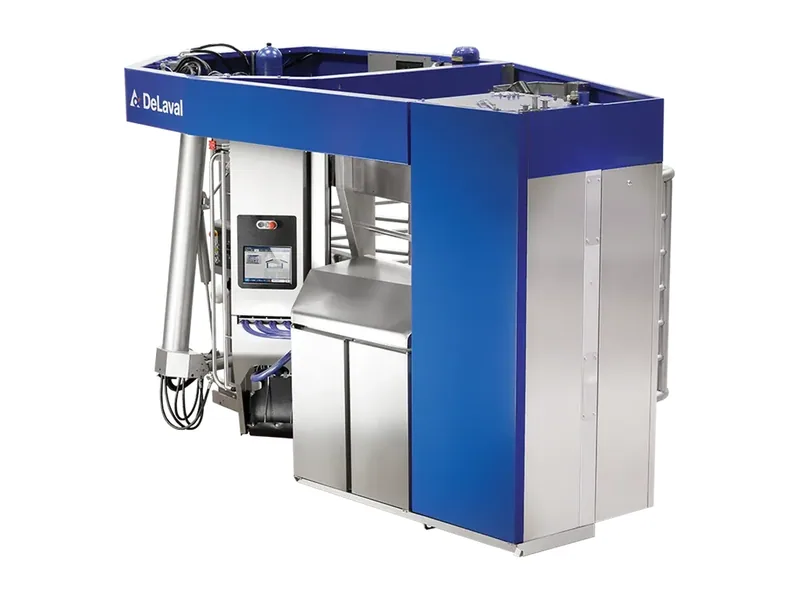
DeLaval VMS Batch Milking
Configuration of multiple V300s to milk cows in scheduled batches like a parlour
Lely Astronaut Max
Central receiver/CIP/vacuum unit connecting several Astronauts for larger herds
What to check before you buy
The robot works around the clock, so fast service near you matters most.
When a milking robot stops, the cows still need milking. Someone must be able to fix it quickly, at any hour.
- Service network: how close is the nearest technician, and do they come at night and at weekends?
- Sensors: which milk quality and health sensors are included, and which cost extra?
- Milk meters: ICAR approval means the meter was tested against an international standard for measuring milk.
- Power and internet: ask about power use, a backup generator for power cuts, and the internet the software needs.
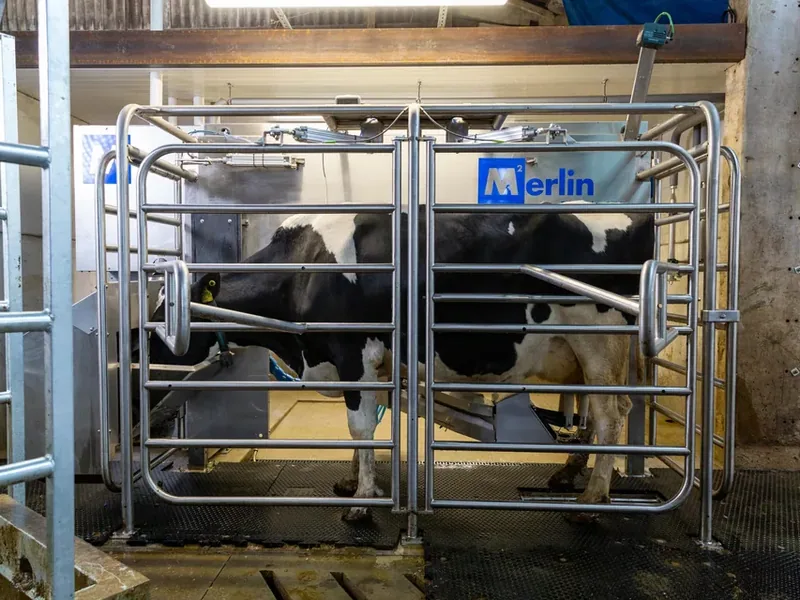
Fullwood Merlin 2+
Single-box milking robot with full electric arm, dual entrance/exit
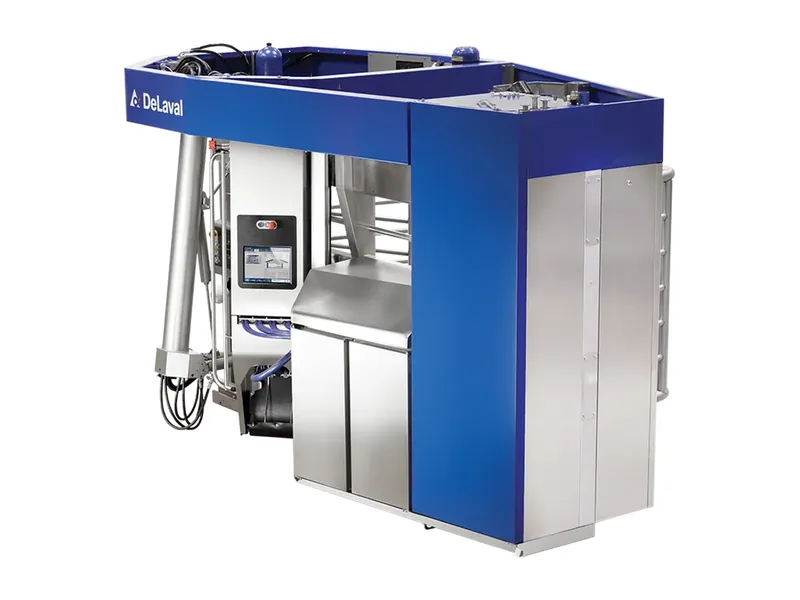
DeLaval VMS V310
VMS V300 plus RePro in-line progesterone sampling
Health sensors and power use
Compare what each robot measures, not only how fast it milks.
Health sensors differ a lot. Fullwood says the Merlin 2+ checks for mastitis in each quarter. Mastitis is an infection of the udder.
DeLaval VMS V310 adds automatic progesterone sampling. Progesterone is a hormone, and the test shows heats and pregnancy.
Fullwood gives a power use of 0.015-0.020 kWh per kg of milk for the Merlin 2+. Ask other makers for the same figure so you can compare.
Fitting it into your barn
Plan cow traffic and floor space before you choose a model.
Cows must reach the robot easily, with feed, water and resting places nearby. Cows that wait long or must turn sharply come less often.
Space differs by model. GEA gives a footprint, the floor area the robot covers, of 5.3 m² for the R9500, and says multi-box layouts save up to 40% space.
Some batch layouts need a lower floor under the robots, called a subway, for pipes and parts. GEA R9600 and R9650 use one. BouMatic says Gemini UP MAX needs no pit or basement.
Check weight and access too. Fullwood gives 1,200 kg for the Merlin 2+, so floors and doors must take it.
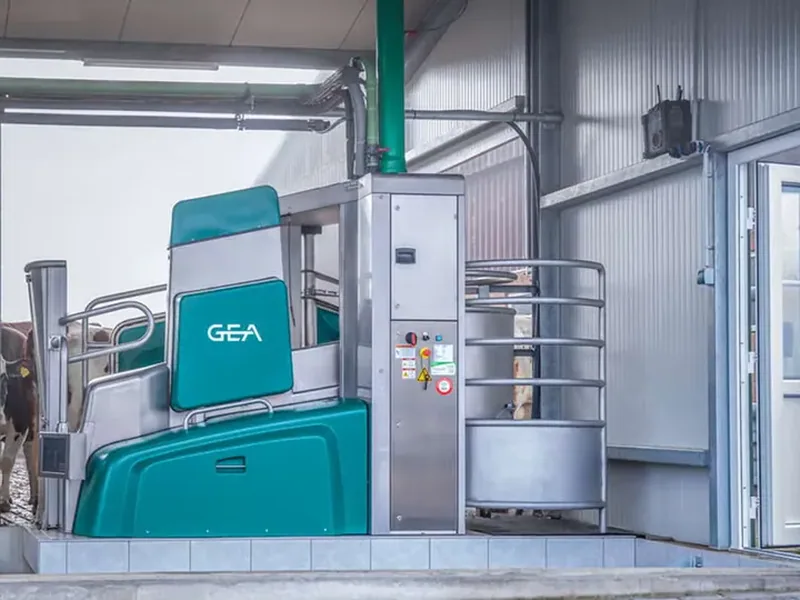
GEA DairyRobot R9500
Voluntary milking robot, single- or multi-box, with in-liner teat prep
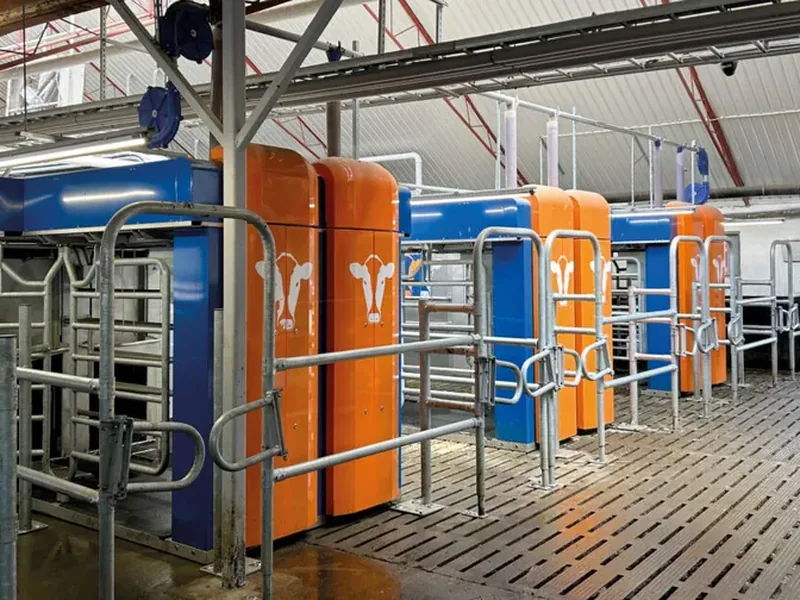
Gemini UP MAX
Batch milking system centralizing multiple compact milking robots in one area to automate milking for large dairy…
Which one is for me?
- Family dairy farm, about 60 cows, free-stall barn: One single-box robot. Check how many cows one box really handles, how it cleans teats, and how close the service team is.
- Tie-stall barn, cows kept in their places: A rail robot that moves to the cows. Check how many cows it covers per day and how much work still stays with people. For example CarryRobo UCA30A.
- Growing herd, adding robots over time: Single boxes that can later share central cleaning and vacuum units. Ask how easy and how costly it is to add a box.
- Large herd, several hundred cows: Batch milking or a robotic rotary. Check how many operators it needs, the milking times, and whether you need a subway or pit. For example GEA DairyRobot R9600 / R9650.
- Farm keeping its rotary parlour: A robot that does one job, such as teat spraying, in the parlour you have. Check that it fits your platform. For example DeLaval TSR.
Compare all 17 milking robots in our catalogue by kind, maker and sensors. Then ask two or three makers with service near you for a quote.
Where the numbers come from
- top agrar, 2022: Gebrauchte Melkroboter kaufen (Farm press)
- LK Niederösterreich in top agrar Österreich, 2024: Was kostet das Melken am AMS? (Farm advisers)
- Utah State University Extension, 2020: Financial analysis of installing an automatic milking system (Study)
- LKV Bayern in top agrar, 2021: Automatisch melken teurer als gerechnet (Farm advisers)
- LWK Niedersachsen in top agrar, 2025: Wartungsverträge für Melkroboter (Farm advisers)
- DLG TestService, 2022: Test report 7376: Lely Astronaut A5 (Study)
- LFA Mecklenburg-Vorpommern, 2021: Robots and parlours on large dairy farms (Study)
- LK Niederösterreich, 2021: Roboter im Rinderstall (Farm advisers)
- Teagasc, 2025: Automatic milking (Farm advisers)
- LWK NRW in top agrar, 2022: Zurück zum Melkstand (Farm advisers)
- LFI Österreich (cost data from 2008–2009), 2019: AMS: tips for a successful start (Farm advisers)
- USDA Economic Research Service, 2026: Report ERR-356: robotic milking and farm returns (Study)
- Animals (MDPI), 2021: Review of automatic milking studies (Study)
- Journal of Dairy Science, 2019: Review of automatic milking (Study)
- top agrar, 2022: Zurück zum Melkstand: darum schaffen einige Landwirte ihren Melkroboter ab (A farmer, in the press)
- Bavarian Agriculture Ministry, 2024: Agrarbericht 2024: farm investment grants (Farm advisers)
- Baden-Württemberg government, 2026: Farm investment grants from 2026 (Farm advisers)