Line marking robot buyer’s guide
Line-marking robots paint sports pitches from a digital plan, in a fraction of the time it takes by hand.
What a line-marking robot does
You choose the pitch on a screen, and the robot paints the lines by itself.
A line-marking robot paints the lines on sports pitches. It works from a digital plan, so it is much faster than marking by hand.
The operator opens an app and picks a pitch template. A template is a ready-made drawing of a pitch, for example football or rugby. The robot then drives over the grass and sprays the lines.
To know where it is, the robot uses satellite positioning (GPS, sometimes called GNSS). An extra correction signal called RTK makes this accurate to about a centimetre. That is why the lines are straight and the curves are round.
Our catalogue lists 16 robots from 10 makers. 14 of them are on sale now.
How much it costs
Almost every maker gives the price only on request, so ask for a full quote.
2 of the 16 robots in our catalogue have a published price. For all the others, you must ask the maker.
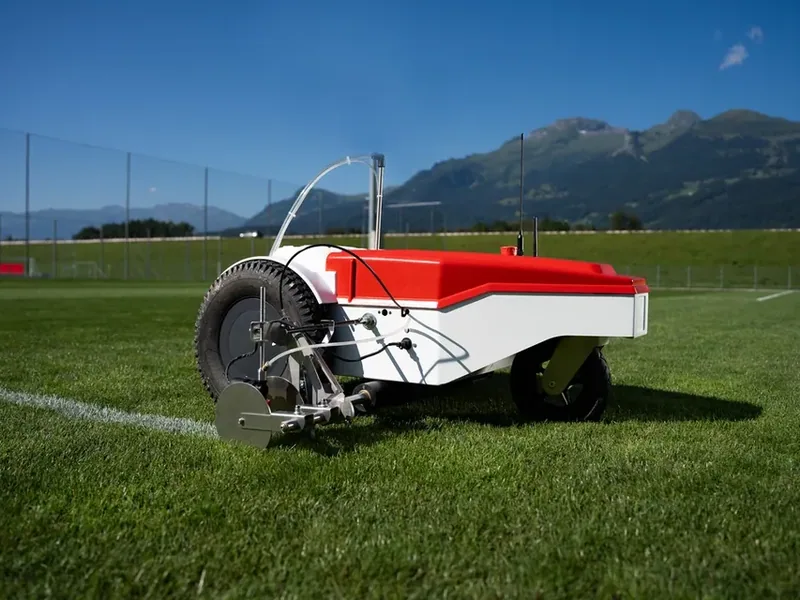
The Fleet robotic line marker is sold as a low-cost model, from £15,000. It is still on pre-order, so it is not delivered yet.
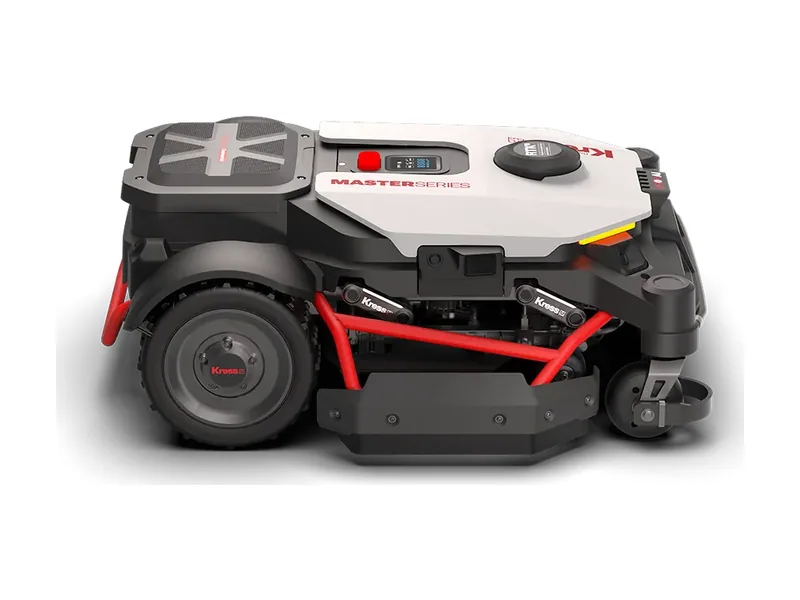
Another published price is for the Kress MasterSeries, at £28,748–30,580. It is a large robot mower. The sports version cuts stripe patterns into the grass, but it does not paint lines.
Some makers sell the robot for a one-off price. Others use a subscription, which is a monthly or yearly fee. Ask what is included: paint, the RTK signal, software updates and repairs.
The main kinds
Decide whether you want a robot that works alone, a guided marker, or a machine that also mows.
Line-marking robots are not all the same. They differ in how much the operator does and in what surface they work on.
Fully autonomous painters
These robots drive and paint on their own. The operator only sets up the job and fills the paint tank.
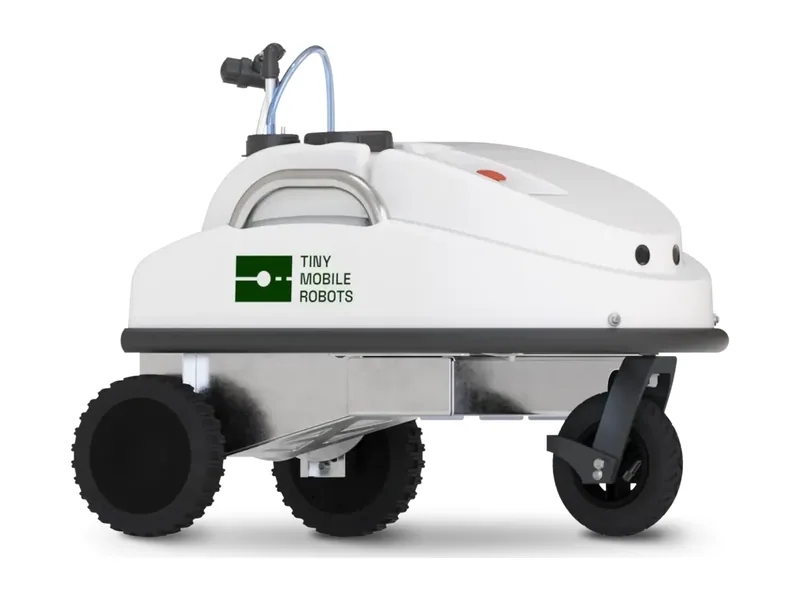
Examples in the catalogue are the SWOZI auto, the TinyLineMarker Sport, the FJD PaintMaster and the Turf Tank robots.
Guided and ride-on markers
Here a person still walks behind or drives the machine. GPS or a laser tracker shows where to go. A laser tracker is a device on a stand that follows the machine with a laser beam.
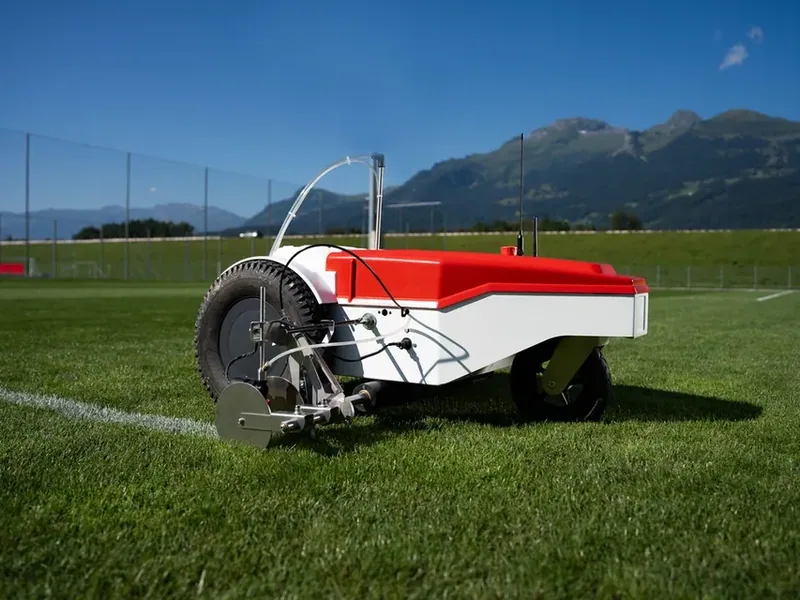
The SWOZI pro, pico, evo and ride-on markers work like this. They suit clubs and contractors who want help, not full automation.
Mowers that also mark
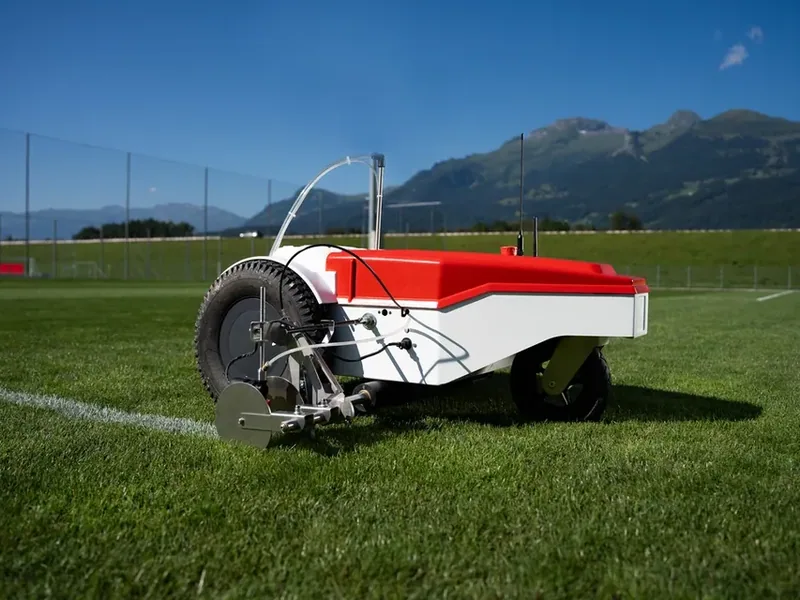
Some machines cut the grass and mark lines. The Stealth Striper mows and marks lines in one pass.
The FJD Titan is a large robot mower with an optional kit for line marking.
Hard surfaces
Some robots paint on asphalt and concrete, not grass. The 10Lines robot paints lines on parking lots, roads, airports and warehouses. The FJD PaintMaster also has Parking and Airfield versions.
SWOZI pro / pico / evo / ride-on
Semi-autonomous (GPS or laser tracker) and GPS-assisted manual/ride-on line markers for clubs and contractors
Stealth Striper
Machine that mows grass and marks lines in one pass
How to size it for your pitches
Count your pitches per week, then check paint tank, battery time and speed.
Think about how many pitches you mark each week and how far apart they are. A bigger tank and a longer battery mean fewer stops.
The specs vary a lot. The FJD PaintMaster has an 8 l tank and runs for about ~2 h. The TinyLineMarker Sport has a 10 l tank, runs for 5 h and needs 6 h to charge. The maker says it marks a football pitch in ~20-25 min.
The Turf Tank One has a 20 l tank and runs for about ~4 h. The maker says it marks at least four full-size football pitches per charge.
Weight matters if you carry the robot between sites. The FJD PaintMaster weighs 21.85 kg, the TinyLineMarker Sport 25 kg and the Turf Tank One 60 kg.
What to check before you buy
Check templates, paint use, the signal and the price model before you sign.
Ask for a demonstration on your own site if you can. Then go through these points.
- Templates: are your sports and pitch sizes included? The TinyLineMarker Sport lists 50 sports and 120 layouts, and the SWOZI auto lists 100+ field templates.
- Paint: how much paint the robot uses per pitch, the tank size, and whether you must buy the maker’s own paint.
- Signal: does RTK come from your own base station or a paid network service? Trees and stands can block the signal. The SWOZI auto has a handlebar so you can push it by hand if GPS drops.
- Price and service: one-off or subscription, training, spare parts and who repairs it near you.
Which one is for me?
- Small club or school with one or two pitches: Look for a light, simple robot that one person can carry and set up. Check that your pitch templates are included and that the price model fits a small budget. For example FJD PaintMaster Mini / Pro / Ultra.
- Contractor or municipality marking many pitches: Look for long battery time, a large paint tank and many templates. Ask about speed per pitch and how easy it is to move between sites. For example TinyLineMarker Pro X.
- Grounds team that also mows large areas: Consider a robot mower with a line-marking kit, or a machine that mows and marks together. Check how the marking quality compares with a dedicated painter. For example FJD Titan.
- Club that wants help but not full automation: Look at guided walk-behind or ride-on markers with GPS or a laser tracker. They often keep a person in control and can be simpler to start with.
- Parking lots, airports or warehouses: Choose a robot built for hard surfaces, not grass. Ask about paint types for asphalt and concrete, and how the robot works indoors where satellite signal is weak.
Compare all 16 line-marking robots in the catalogue by tank size, battery time and templates. Then ask two or three makers for a full quote that includes paint and the RTK signal.