Feeding robots and feed pushers
Feeding & feed pushing buyer’s guide
Feeding robots mix and deliver feed and push it back to the cows so there is always food at the barrier.
What feeding robots do
A feed pusher keeps feed within reach. A full feeding system also mixes the feed and brings it to the animals.
Cows push feed away from the feed fence as they eat. The feed fence is the barrier where the animals put their heads through to eat.
A feed pusher is a small robot that drives along the feed alley on a schedule. It pushes the feed back to the fence so there is always food in reach, day and night.
A full feeding system does more. It loads feed from a feed kitchen (a storage area for silage, hay and other feed), mixes the ration and drives it to each group of animals.
Our catalogue lists 45 robots from 24 makers. 41 of them are on sale now.
Lely Juno
Autonomous feed-pushing robot along the feed fence
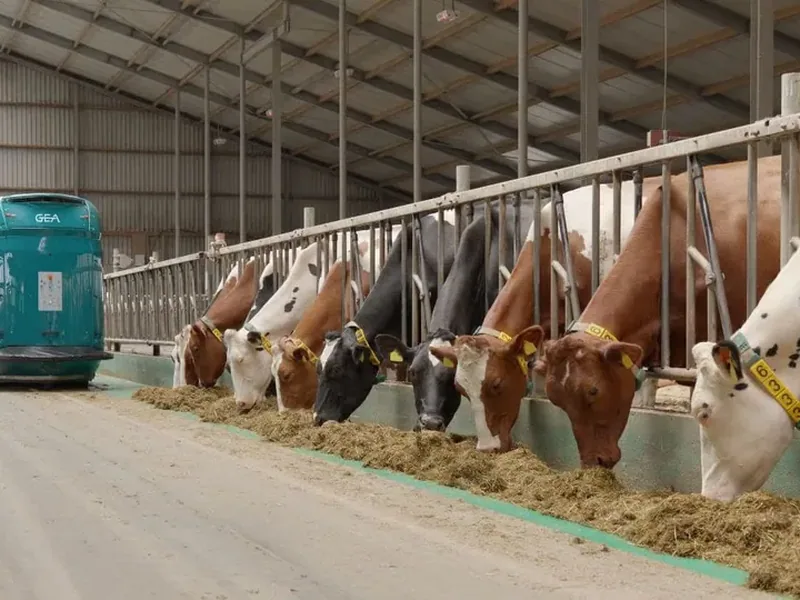
GEA DairyFeed F4500
Autonomous feeding robot that weighs, mixes and distributes TMR in small portions
How much it costs
No maker publishes a price, so ask several makers for a quote for your own barn.
Only 1 of the 45 robots in our catalogue has a published price. All of them are sold on request, usually through a local dealer.
The price depends a lot on what you need. A feed pusher alone costs much less than a full system with a feed kitchen, a mixing robot and building work.
Ask each dealer what the quote includes. Some makers also talk about running costs; for example, one maker claims its system divides the feeding energy bill by three.
- Installation, rails, cables or floor markers
- Feed kitchen, storage units or bale cutters
- Charging station and power connection
- Service contract and spare parts
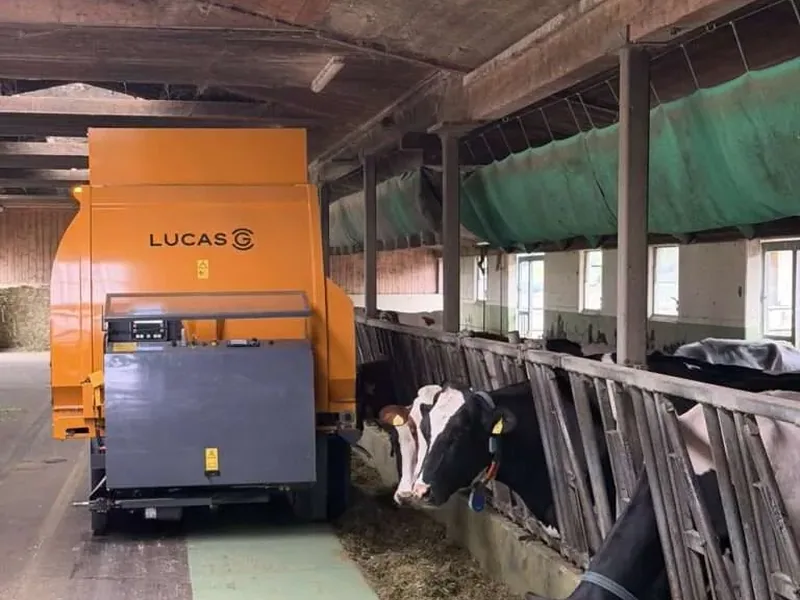
Push only or full feeding
First decide if you only need feed pushed back, or if you want the robot to mix and deliver feed too.
This is the biggest choice. It decides the price, the space you need and how much work the robot takes off your hands.
Push only
The robot pushes feed that you or a mixer wagon put down. You still mix and deliver the ration yourself.
Some pushers check how much feed is left and push more or less to match.
Push and loosen
Some pushers have a turning screw, called an auger, at the front. It loosens and remixes the feed as it moves it, instead of pressing it flat.
This can help keep feed fresh and easy to eat at the fence.
Full mixing and feeding
The robot takes feed from a feed kitchen, weighs it, mixes it and drives it to each group. TMR (total mixed ration) means all feeds are mixed together into one ration.
It can feed small portions many times a day. Some systems mix batches from about 60 kg, and one feed kitchen stores up to about three days of feed.
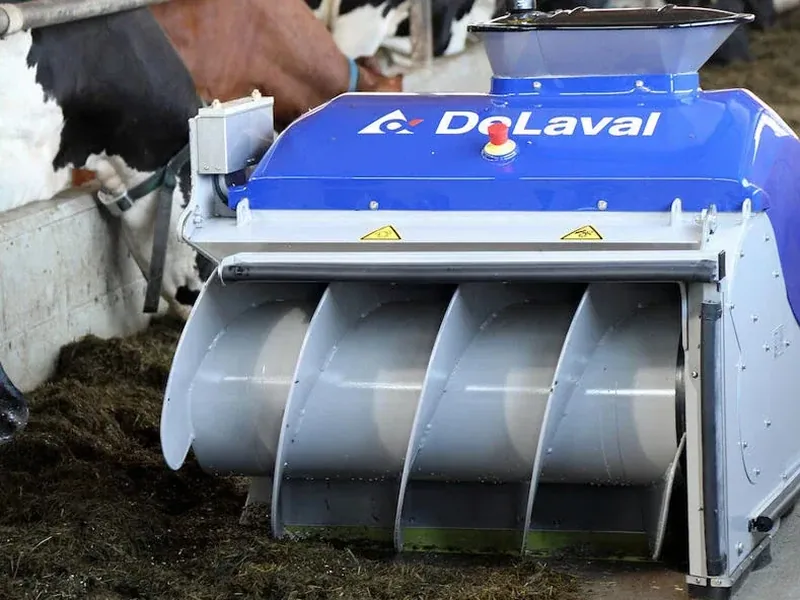
DeLaval OptiDuo
Robotic feed pusher that also remixes feed with twin-spiral rotating auger
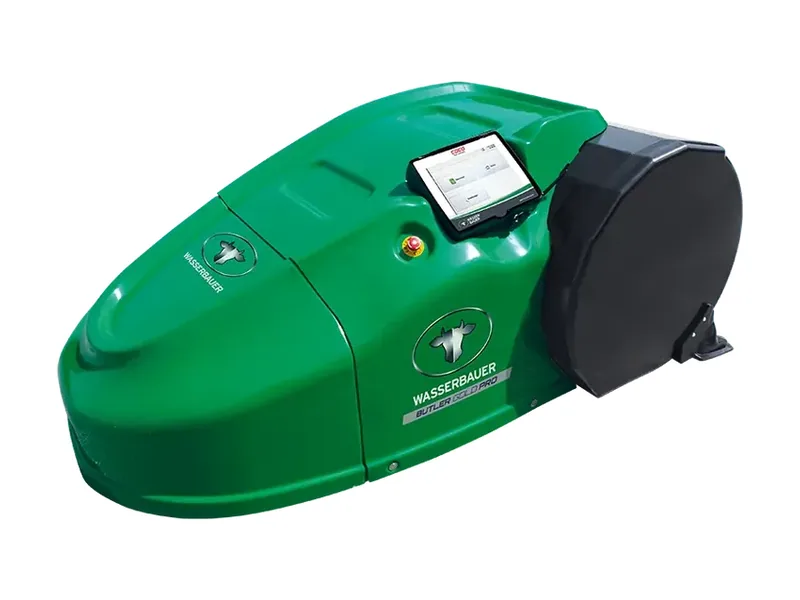
Butler Gold Pro
Feed pusher with patented conveyor screw that loosens feed instead of compacting it
How the robot finds its way
Rails, floor guides or free navigation: the right one depends on your barn layout.
Every robot needs a way to follow the right route. Some need fixed parts in the barn, others use sensors.
On a rail
The robot hangs from or runs on a rail fixed in the barn. It suits narrow or low alleys and tie-stall barns, where cows are tied in their places.
Rails limit slopes. One rail-suspended robot handles a gradient of 2%, or 14% with a rack-and-pinion drive (a toothed rail).
Floor guides
A cable, magnetic tape or small tags called transponders are put in or on the floor. The robot follows them like a track.
This is simple and reliable, but you must change the floor guides if you change the route.
Free navigation
The robot uses cameras, sensors or GPS to build a map and find its own way. Some can drive between barns and around obstacles.
LIDAR is a laser scanner that measures distance. RTK GPS is a very accurate form of satellite positioning, used outdoors.
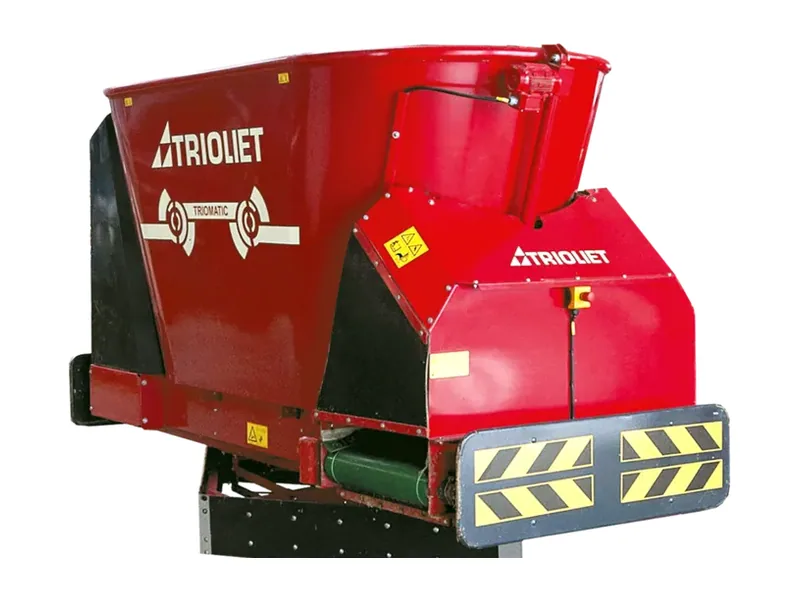
Triomatic HP 2 300
Rail-suspended mixing and feeding robot
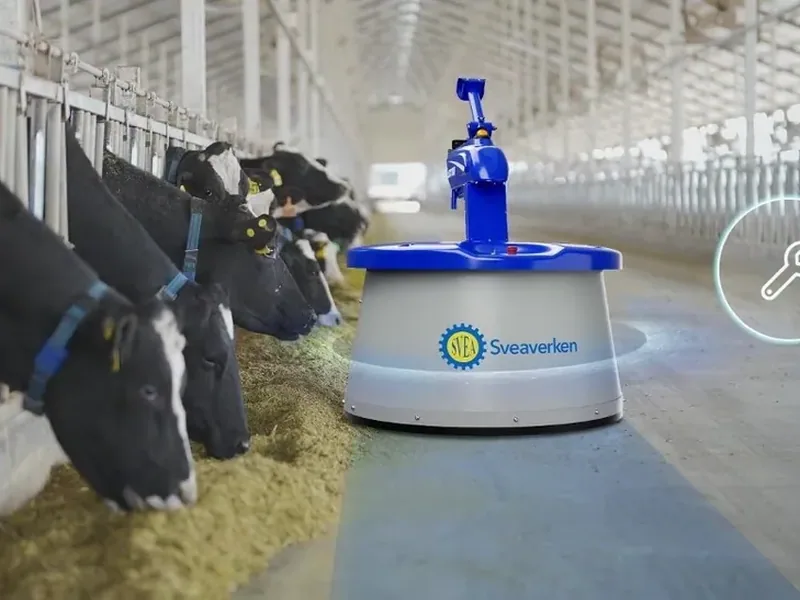
Nimbo / Nimbo Plus
Self-driving feed pusher with AI visual navigation and obstacle detection.
Size it for your farm
Count your groups and rations, then measure your alleys, slopes and doorways.
Start with your animals. How many groups do you feed, and how many different rations? One system in our catalogue feeds up to 300 animals in multiple groups; another claims up to 800 cows a day.
Then measure the barn. Robots need a minimum alley width, for example 2.3 m for some models, and they can only cross low steps, such as up to 40 mm or 2.5 cm depending on the model.
Check the slopes on the route. Makers state maximum slopes from 5% up to 20%.
Speed matters on long feed fences. Feed pushers in our catalogue drive from 12 m/min to 30 m/min.
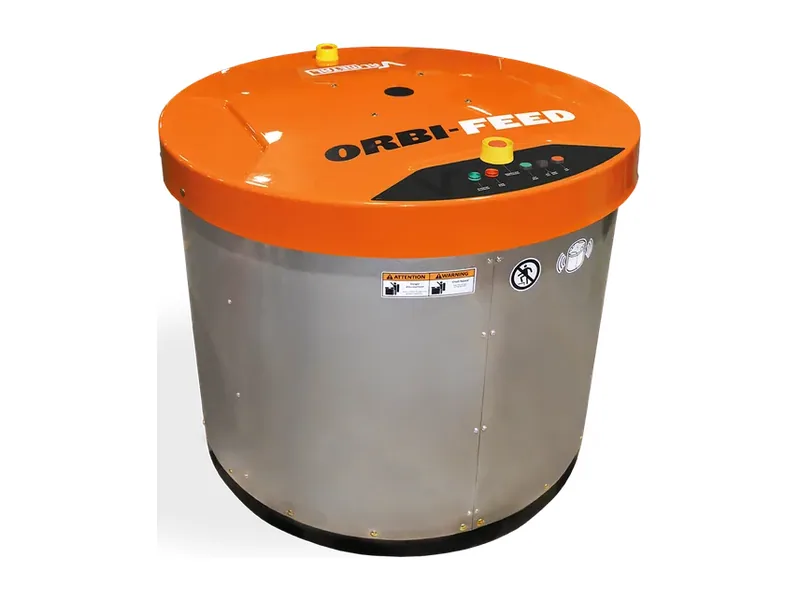
Valmetal Rotary feed pusher
Robotic feed pusher with rotating body
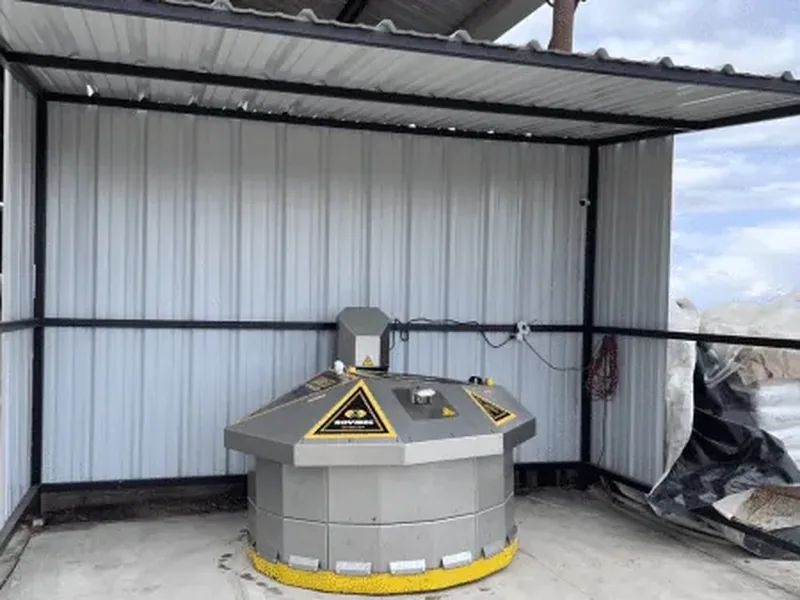
RANGER Nitro Li3
Autonomous feed pusher adjusting push to remaining feed
What to check before you buy
Power, safety, doors and service decide how well the robot works every day.
Power comes in different ways. Most robots use a battery and a charging station; some mixing robots get power from an overhead rail and need a strong electric connection, such as 400 V.
Ask how the robot stops for people, animals and tractors. Look for obstacle sensors and a safety bumper.
If the route goes through doors or gates, ask if the robot can open them itself. Also ask if it connects to your herd management software or an app on your phone.
Finally, ask who does the service, how fast they come and where spare parts are kept.
- Battery type and charging
- Obstacle sensors and safety bumper
- Door and gate control
- Local service and spare parts
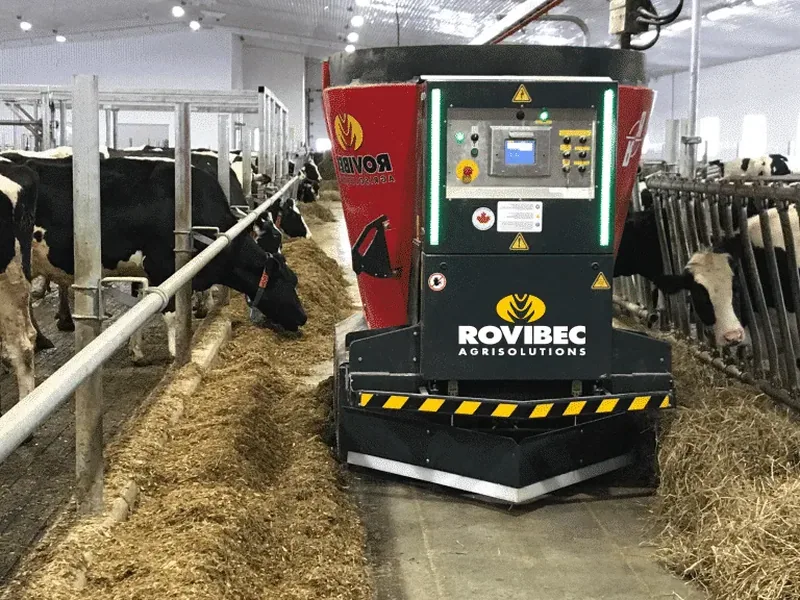
Rovibec ROVER feeding robot
Self-guided mixing and feeding robot powered via overhead conductor rail
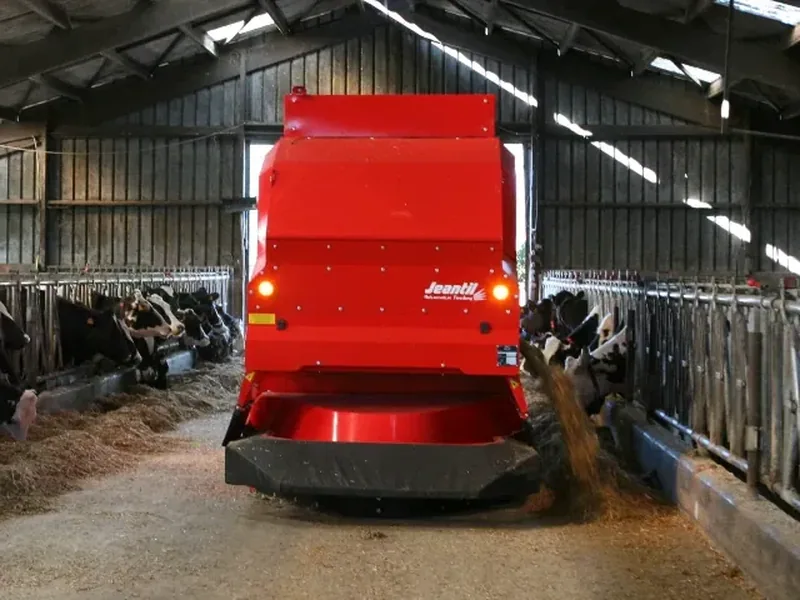
JEANTIL Automatic Feeding
Wire-guided, battery-electric autonomous feeding cart that distributes rations on programmed cycles.
Not only for dairy cows
There are also robots for beef, pigs and poultry, and some new ideas still in testing.
Some feeding robots are made for fattening bulls, for pigs on rails along the pens, or for chicken coops that move across the pasture with solar power.
A few robots are still at pilot stage, which means they are being tested on farms and may not be on sale yet. One is a self-driving mixer that loads, mixes and pushes feed; another mows fresh grass in the field and brings it to the barn.
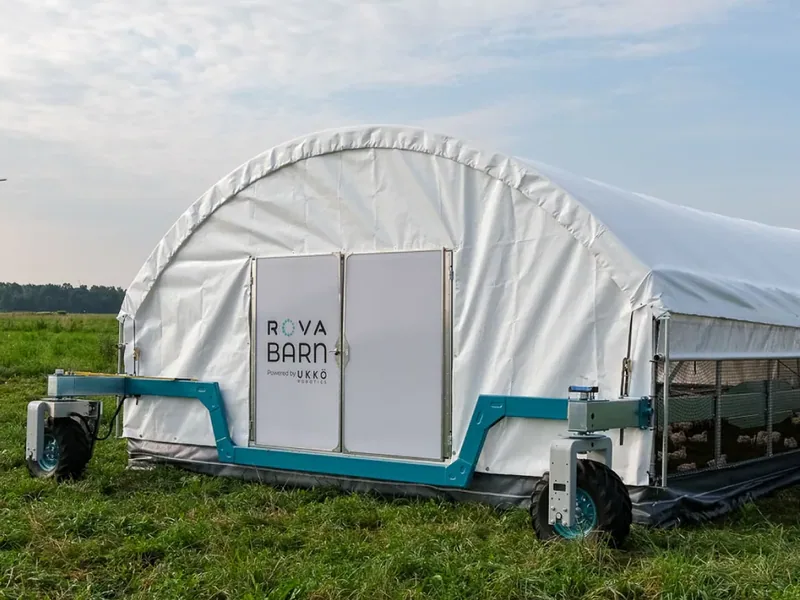
ROVA|BARN 700
Self-moving solar pasture barn that relocates daily onto fresh pasture, with onboard feed, water and smart…
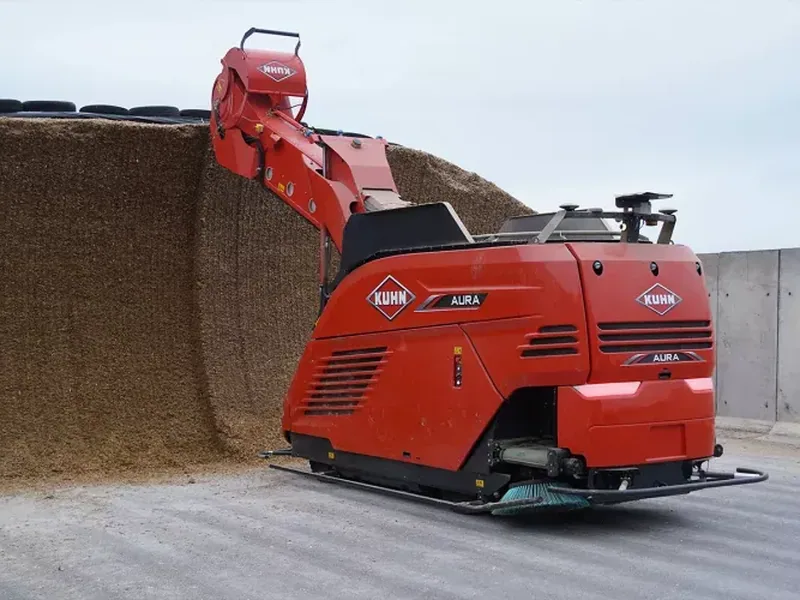
AURA
Autonomous self-propelled TMR feed mixer that loads silage, weighs, mixes, distributes and pushes back feed for…
About €300,000
Which one is for me?
- Small dairy farm with a single feed alley: A feed pusher is often enough. Check the slope it can handle, how it is guided and if it fits your alley width. For example JOZ Moov 2PRO.
- Large dairy farm with several groups and rations: Look at a full mixing and feeding system with a feed kitchen. Ask how many groups and rations it can handle and how many days of feed the kitchen holds. For example Lely Vector.
- Tie-stall or older barn with low, narrow alleys: A rail-guided robot can work where wheeled robots do not fit. Check the robot's height, width and distribution width. For example Pellon Combi robot.
- Beef or mixed farm with several barns: Choose a robot that can drive between buildings without rails. Check the minimum alley width, steps at doorways and slopes outside. For example Triomatic WB.
- Small poultry keeper on pasture: A self-moving coop with feed and water on board can save daily work. Check the number of birds it holds and its solar power and battery. For example ROVA|BARN Micro.
Every barn is different, so compare several models before you ask for quotes. Use the catalogue to filter the 45 feeding and feed pushing robots by type, navigation and maker.