Drilling & anchor setting robots: buyer’s guide
Drilling robots make holes in ceilings and walls for anchors, installations and facade brackets, a tiring overhead job for people.
What a drilling robot does
The robot drills the holes for fixings, so people do not have to work overhead all day.
A drilling robot makes holes in ceilings, walls or floors. Workers then put anchors in these holes. An anchor is a fixing that holds a bolt in concrete, so pipes, cables, lights or brackets can hang from it.
Drilling into a ceiling for hours is hard, dusty and tiring work. The robot takes over this part of the job.
The robot reads the drilling points from the BIM model. BIM is the digital 3D model of the building that the designers make.
It finds its exact position with a total station. A total station is a surveying instrument that measures angles and distances very precisely. Then the robot drives to each point and drills, often with a vacuum that takes away the dust.
How much it costs
No maker publishes a price, so you must ask each maker for an offer.
Our catalogue lists 14 drilling robots from 10 makers. None of them has a published price. Every robot is "price on request".
8 of the 14 robots in our catalogue are on sale now. The others are pilots (tested on real sites), prototypes, or no longer made.
Ask the maker if you can buy, rent or pay per project. Also ask what is included: training, software, the total station, and service on site.
The main kinds
Choose the kind that fits where you drill: ceilings, a lift shaft, a facade or the floor.
All these robots drill holes, but they are built for different places on a building site.
Ceilings and walls inside
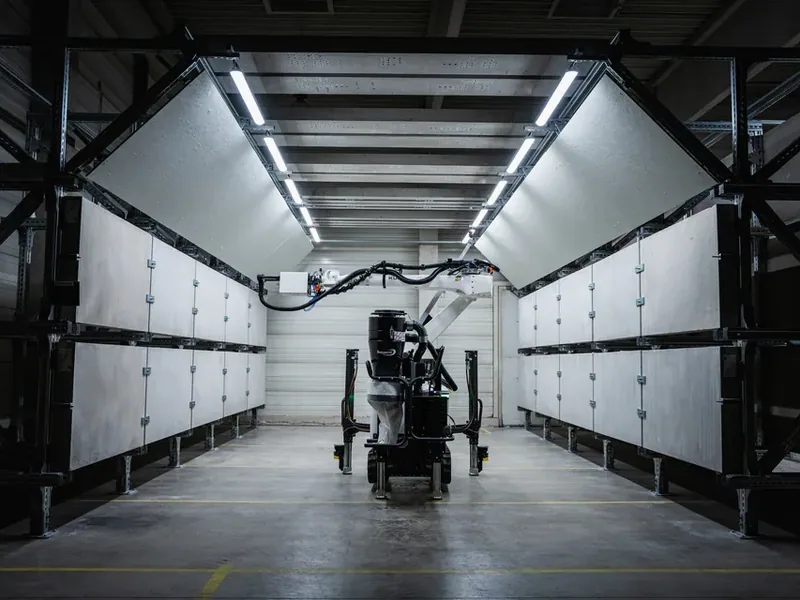
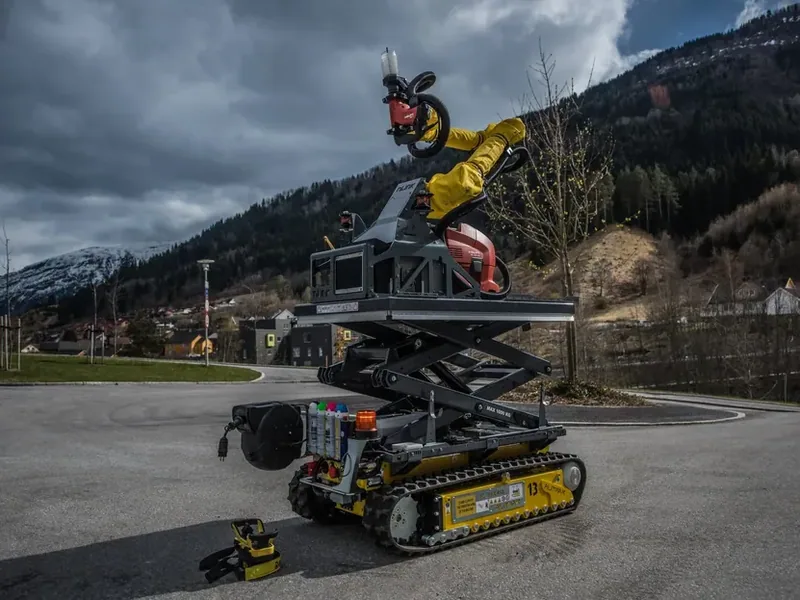
This is the most common kind. A robot on wheels or tracks drives through the floor and lifts a drill or a robot arm to the ceiling.
Some do only drilling. Others, like the BAUBOT models, carry an industrial arm that can also mill, pick and place parts, or print concrete.
In the lift shaft
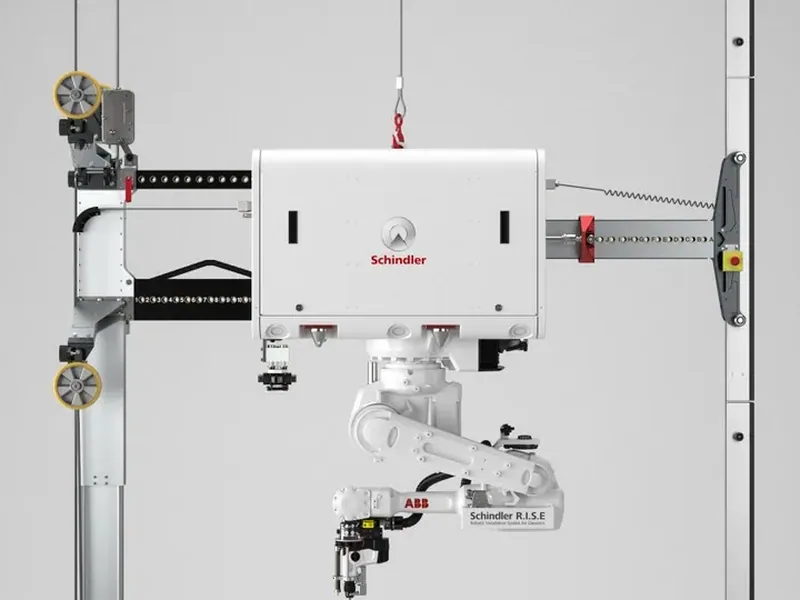
The Schindler R.I.S.E climbs up the elevator shaft by itself. It drills and sets the anchor bolts for rails, doors and brackets.
Makers say it works around the clock after setup and can find steel bars (rebar) in the wall so it does not hit them.
At the slab edge and facade
These robots work at the edge of each floor or on the outside wall. They drill and fix the brackets that hold glass or panel facades.
Some sit on a mobile base at the slab edge. Others hang from cables and move over the whole facade. Most of these are still prototypes.
Into the floor
A few robots drill many holes straight down into the floor, for example in data centres, where long rows of equipment must be fixed in line.
How to size it for your job
Match the robot to your ceiling height, your floor strength and the number of holes you need.
First count your holes. A robot only pays off when there are many holes of the same kind, for example hundreds of anchors for sprinkler pipes or lights.
Check the height. The BAUBOT MRS15 reaches ceilings and walls up to 4 m. Higher ceilings need a robot that works from a lift, or another tool.
Check the weight and size. The BAUBOT MRS15 weighs under 1300 kg, while the smaller MRS5 weighs 500 kg. On older floors or in small rooms, a lighter robot may be the only choice.
Check how long it runs. The Hilti Jaibot runs up to 8 hours between charges, so it can work a full shift.
What to check before you buy or rent
Ask about speed, accuracy, materials, dust and the support you get on site.
Ask the maker for holes per hour and accuracy on a site like yours, not only in a test hall. For example, the discontinued Drilly drilled more than 500 holes in one workday.
Ask which materials it can drill. Some robots work only in concrete, some also in metal deck (thin steel sheets under a concrete floor).
- Dust: is there a vacuum, and how much dust can it hold?
- Rebar: can it detect steel bars and stop before hitting them?
- Data: does it read your BIM files, and who prepares the drilling points?
- Support: who trains your staff, and how fast does a technician come?
Is it right for a farm or a small building
These robots are made for large construction sites, not for a few holes.
Drilling robots need a digital building model, a total station and a trained operator. Setup takes time before the first hole.
For a barn, a shed or a small repair, a person with a drill is usually faster and cheaper. If you build or refit a large building, ask your contractor if they use a drilling robot.
Which one is for me?
- MEP or fit-out contractor, many ceiling holes in new buildings: Look for BIM support, total station positioning, dust removal and a full shift of battery time. Check it drills both concrete and metal deck. For example Jaibot.
- Refurbishment of older buildings, tight rooms or weak floors: Look for a small, light robot that fits through doors and lifts. Check its weight against the floor load and the arm reach against your ceiling height. For example BAUBOT MRS5.
- Lift installer or main contractor on high-rise jobs: Look for a robot made for the shaft, which climbs by itself and sets anchors for rails and doors. Ask the lift maker how it fits with their own lift products.
- Facade or curtain-wall contractor: Look at slab-edge and facade robots, but check the stage first. Several are still prototypes, so ask for site results and who supports it.
- Farm or facility manager with a few installations: A drilling robot is usually not worth buying. Hire a contractor, and ask if they use a robot for large ceiling jobs.
Compare all 14 drilling and anchor setting robots in our catalogue, check which ones are on sale, and ask the makers for an offer for your job.