Calf feeders buyer’s guide
Automatic calf feeders give each calf its milk or milk replacer in small portions through the day, mixed and warmed to the right temperature.
What a calf feeder does
The feeder gives each calf its own amount of milk, in small portions through the day.
An automatic calf feeder mixes milk or milk replacer and warms it to the right temperature. Milk replacer is a powder that is mixed with water to make a milk drink.
The calf walks into a feeding station and drinks from a teat. The station reads the calf's ear tag, gives the amount set for that calf and records how much it drank.
The ear tag has a small chip. A reader in the station recognises it without touching it. This is often called RFID.
Because the feeder records every visit, you can see quickly when a calf drinks less than usual. That is often the first sign that it is sick.
How much it costs
No maker publishes a price, so you must ask for a full quote.
Our catalogue lists 16 calf feeders from 7 makers. All of them are on sale now. None of them has a published price.
The price depends on how many stations you need, whether it feeds milk, powder or both, and how much software and cleaning comes with it.
When you ask for a quote, ask what is included. Check these points:
- Installation, stations, hoses and ear tags
- Software, app or cloud service, and any yearly fee
- Service visits and spare parts such as teats and hoses
- Training for the people who will look after it
The main kinds
Choose the kind that fits how your calves are housed: in groups, in single pens or in hutches.
The right kind depends mostly on your housing. Group pens, single pens and outdoor hutches each need a different system.
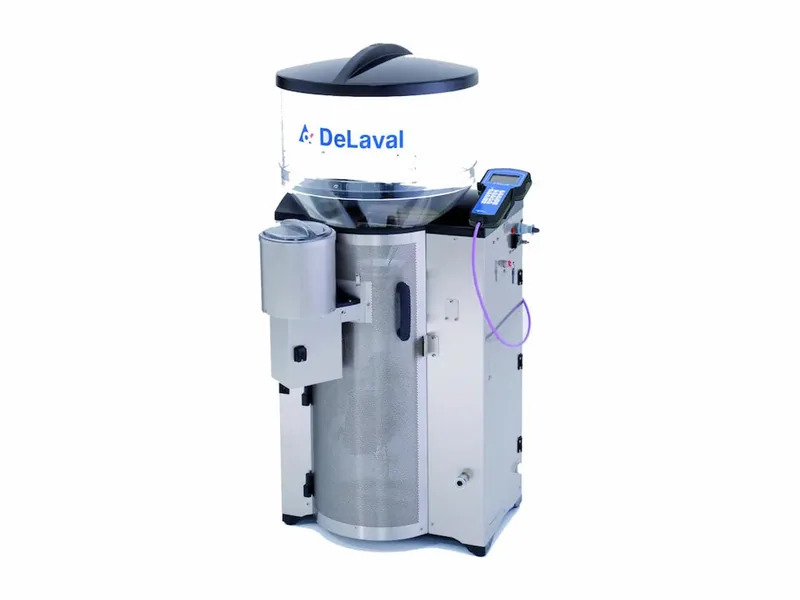
Feeding station for groups
Calves live together in a pen and visit a fixed station when they want. The station knows each calf by its ear tag.
One machine, often called the feeder or processor, mixes the milk and can supply several stations.
Rail feeder for single pens
A feeding arm runs on a rail above a row of single or pair pens. It stops at each pen and gives that calf its own portion through a teat.
These systems clean themselves after feeding. One maker lists up to 50 calves per rail, with up to two rails on one feeder.
Mobile milk cart
A cart heats and mixes the milk and carries it to calves in hutches or igloos. It doses each numbered hutch by a feeding plan based on the calf's age.
Tank sizes listed in our data are 120, 200 and 300 L.
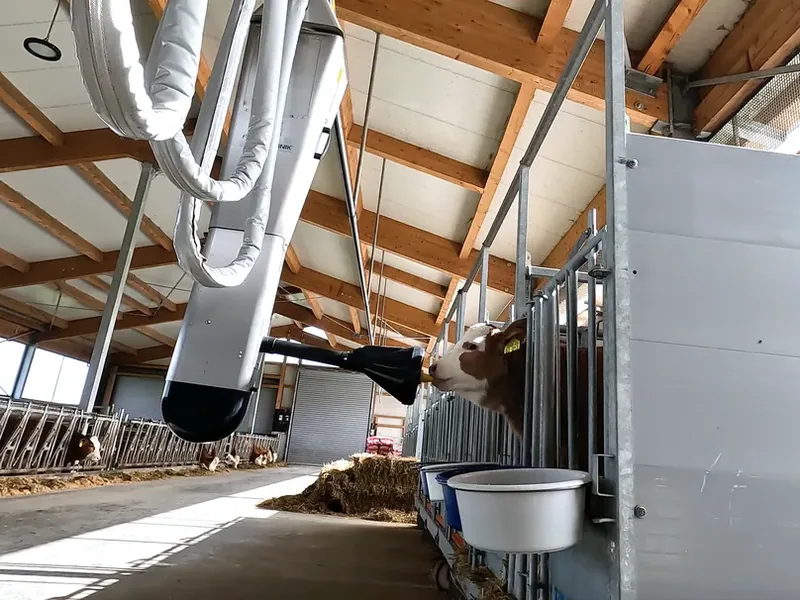
CalfRail
Rail-mounted feeding arm that travels above individual calf pens and gives each calf its own milk portion, then…

MilchMobil PRO
Mobile milk cart that heats and mixes milk and doses each numbered hut by an age-based feeding plan.
How to size it for your farm
Count your calves on milk at the busiest time, then work out how many stations you need.
The key number is calves per station. Makers in our data give from 20-32 calves per station, and up to 25 calves per station for another model.
Total capacity varies a lot. Listed models go up to 70 calves with two stations, and up to 100, 120, 128 or 140 calves with four stations.
Plan for your busiest calving season, not the average. Too many calves on one station means more queuing and more stress for weaker calves.
Also check the space. One group feeder in our data needs about 1 x 1 m of floor space for the machine.
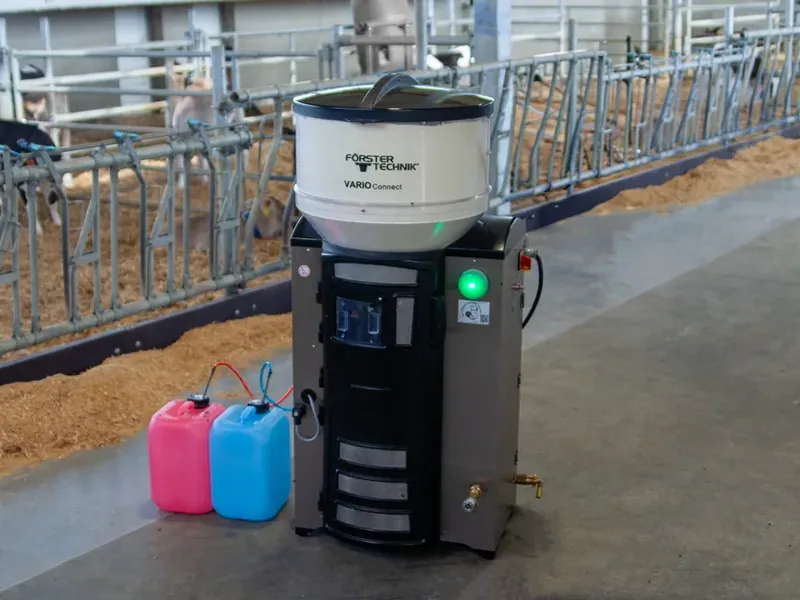
VARIO Connect
Automatic calf feeder that mixes milk replacer or fresh milk per calf at up to four drinking stations.
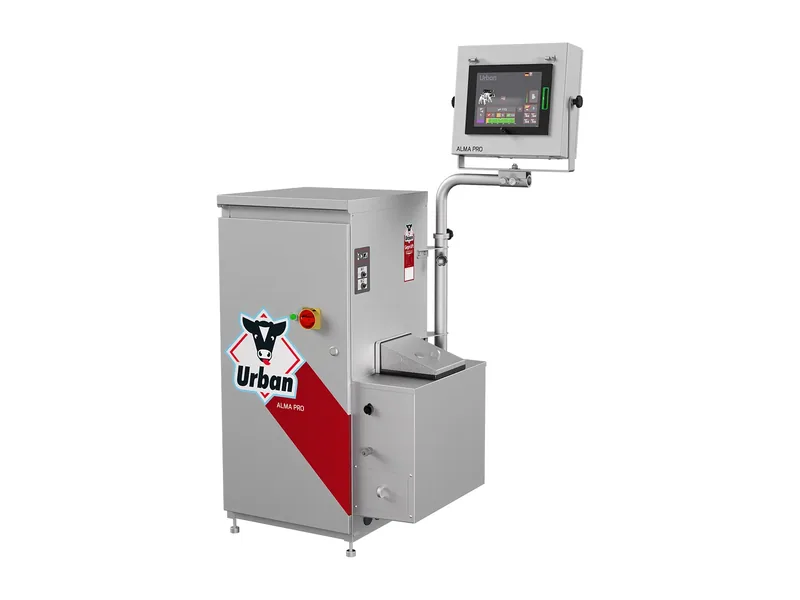
Urban Alma Pro
Automatic calf feeder that identifies calves by ear tag and mixes milk replacer or whole milk per calf at up to…
Milk, powder or both
Decide if you will feed your own whole milk, milk replacer, or a mix of both.
Some feeders work with powder only. Others can also use whole milk from your own cows, or a combination of both.
If you feed whole milk, ask how the milk is stored, warmed and kept clean. Some mobile carts can pasteurise milk, which means heating it to kill germs.
For powder, check the size of the hopper. The hopper is the container that holds the powder. A bigger hopper means fewer refills.
What to check before you buy
Clean hoses, good alarms and the right power supply matter as much as the feeder itself.
Dirty hoses and teats spread disease between calves. Look for automatic cleaning of the hoses, mixer and teat, and ask how often it runs.
Good data helps you act early. Check that drinking data and alarms reach your phone, an app or your herd software.
Check your power supply. Some feeders need a 400 V connection for the heater, and others can run on 230 V.
Ask who services the feeder near you, how fast they come, and which parts you will replace often.
- Automatic cleaning of hoses, mixer and teat
- Alarms when a calf drinks less
- Power: 230 V or 400 V
- Local service and spare parts
Which one is for me?
- Smaller farm, up to 70 calves on milk: A compact feeder with one or two stations is often enough. Check that it is easy to clean and that alarms reach your phone. For example COMPACT Connect.
- Larger farm or calf rearer with group pens: Look at feeders with up to four stations and enough calves per station for your busiest season. Good herd software and remote alarms will save time. For example GEA DairyFeed F4110 / F4120.
- Calves in single or pair pens: A rail feeder brings milk to each pen, so you keep the pens and still feed each calf its own amount. Check how many pens one rail can serve. For example CalfRail DUO.
- Calves in outdoor hutches or igloos: A mobile milk cart can warm, mix and dose milk for each hutch by age. Check the tank size and whether it can heat or pasteurise your own milk.
- Dairy farm feeding its own whole milk: Choose a feeder that handles fresh milk, or milk and powder together. Ask how the milk is stored, warmed and cleaned out of the system.
Every calf feeder in our catalogue is sold on request, so compare the stations, capacity and cleaning of each model first. Then ask two or three makers for a full quote.