Bricklaying & masonry robot buyer’s guide
Robots that lay bricks and blocks or help masons lift heavy blocks.
What bricklaying robots do
They either build the wall themselves or take the heavy weight off the mason.
These robots help build walls from bricks and blocks. Some lay the blocks themselves. Others lift the heavy block so a person can put it in place without carrying the weight.
Our catalogue lists 8 robots from 6 makers. 6 of them are on sale now. 3 of them have a published price.
- Fully automatic machines that lay blocks from a building plan
- Lift-assist arms that carry the weight while the mason guides the block
The two main kinds
Choose a block-laying machine for big repeat jobs, or a lift-assist arm to help the crew you already have.
The choice depends on who should do the placing: the machine or your masons.
Fully automatic block layers
These machines read a digital plan of the walls and place each block in the right spot. Some sit on a truck with a long boom (an arm that reaches out over the site). Others are smaller machines that drive around inside the building.
One truck-mounted machine reaches up to 32 m and lays up to 360 blocks per hour. Another mobile machine builds about 7.5 m² of wall per hour, with a maximum of 10 m².
Lift-assist arms
A lift-assist arm holds the block for the mason. The mason still decides where it goes and sets it by hand, but does not carry the weight.
Payload means the heaviest load the arm can hold. In our catalogue this goes from 100 lb (45 kg) up to 200 lb. Grippers are the tools that hold the block; some use vacuum suction.
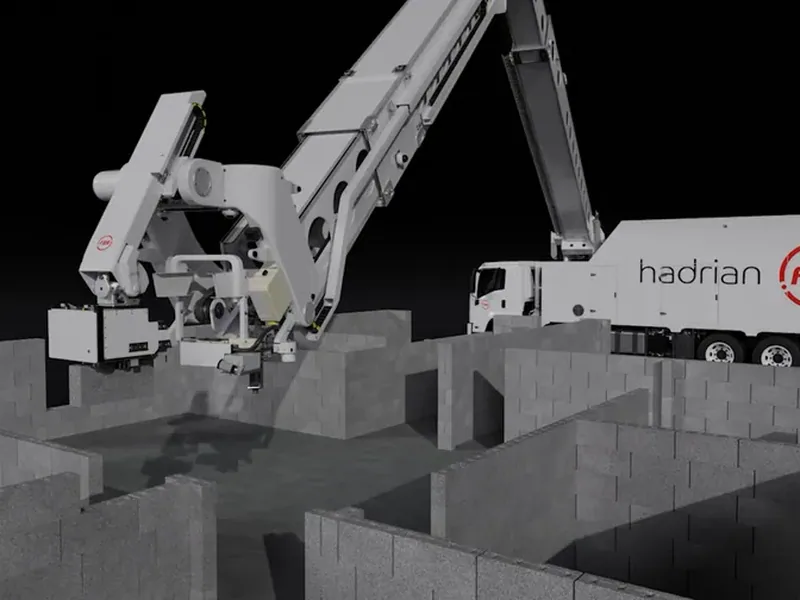
Hadrian
Truck-mounted robotic block-laying machine with telescopic boom and Dynamic Stabilisation Technology, lays…
From A$7,800,000
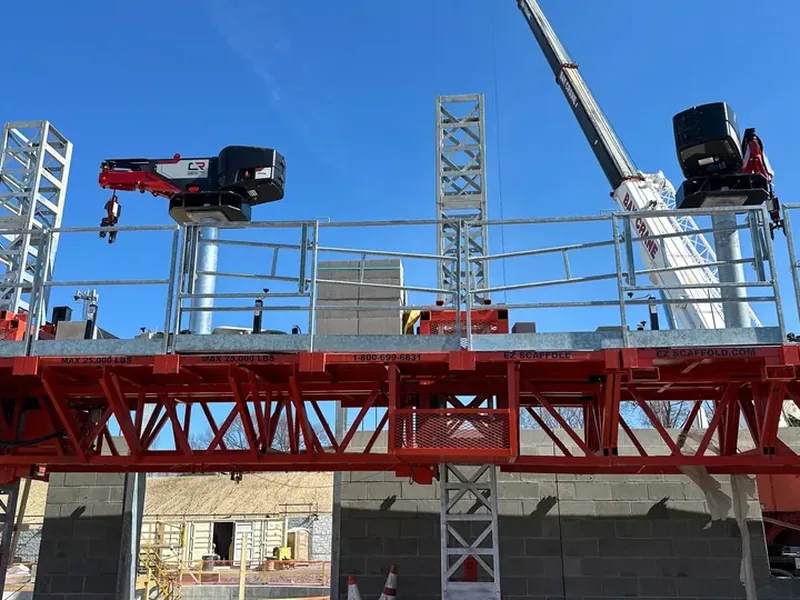
MULE MZ100
Lift-assist arm that carries the weight of heavy blocks/panels so a mason or installer places them by hand
From $1,465 per month
How much they cost
Lift-assist arms cost a monthly amount; full block-laying machines are a very large investment.
3 of the 8 robots in our catalogue have a published price. Two lift-assist arms are listed from $1,465 per month.
The truck-mounted block-laying machine is listed from A$7,800,000. All other models give a price only on request.
Ask each maker what the price includes. Check training, grippers, delivery to site, service and spare parts.
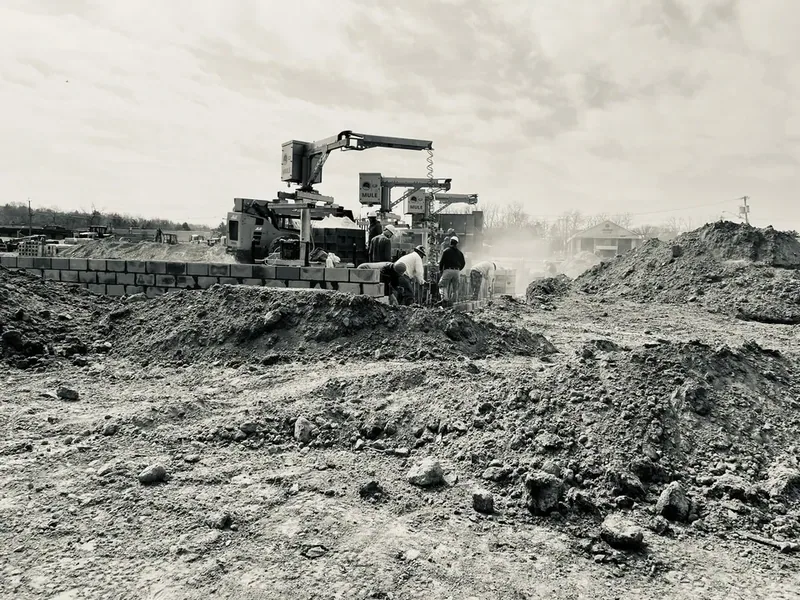
Sizing the robot to your job
Match the work rate, block size and wall height to the walls you build most.
First look at speed. Makers give it as blocks per hour or square metres of wall per hour. Compare it with how fast your crew works today.
Then check the largest block and weight the robot can handle. One machine takes blocks up to 600x400x300 mm and a maximum of 45 kg.
Check how high the robot can build. One mobile model builds walls up to 3.50 m high.
Finally, think about getting the robot onto the site. A truck needs road access and room to park. A machine that drives indoors can weigh 2,500 kg, so the floor must carry it and it must fit through your openings.
Blocks, mortar and glue
Many robots only work with certain blocks or adhesives, so check this before anything else.
Mortar is the wet cement mix that masons spread between bricks. Some robots use mortar and standard bricks, so they fit a normal building plan.
Other robots use adhesive, a strong glue, instead of mortar. One model only works with Porotherm Robot Ready clay blocks and Dryfix adhesive foam.
If a robot needs special blocks, check that you can buy them near you and that your architect and engineer accept them for load-bearing walls (walls that hold up the floors and roof).
What to check before you buy
Ask how many people are still needed, who runs the robot, and whether the model is fully on sale.
No robot here builds a house alone. Ask how many people you still need to feed blocks, mix mortar, set out the site and finish the joints.
Some makers sell the machine. One maker builds the walls for you with its own fleet of electric robots, which can work around the clock. In that case you buy the service, not the robot.
Check the stage of the product. One model is still at the pilot stage (tested on real jobs, not yet widely sold), and one older model is no longer sold.
Also check local building rules and approvals. For example, one pilot robot is approved by NHBC, a UK body that checks new homes.
- Power: battery, mains electricity or the truck engine
- Safety zones around a moving boom or arm
- Service: who repairs it and how fast
- Training for your crew
Which one is for me?
- Masonry contractor building retaining walls with heavy blocks: Look at a lift-assist arm with a high payload, up to 200 lb. Check which grippers come with it and whether you need vacuum grippers for your blocks.
- Small crew lifting blocks or panels all day: A smaller lift-assist arm with a 100 lb (45 kg) payload may be enough. Check the battery, the reach and whether it fits on your site when stowed.
- Large builder with many similar houses: A fully automatic block layer can make sense when you build the same walls again and again. Check blocks per hour, the block sizes and adhesive it needs, and truck access to each plot.
- Developer who wants walls built but not a machine to own: Look at makers that run their own robots on your site as a service. Ask about speed, how many of your people are still needed and what the price on request includes.
- Builder using clay blocks for inside and outside walls: A mobile machine that drives inside the building may suit you. Check that it accepts the blocks and glue you use, the maximum wall height and that your floors can carry its weight.
Every robot in the catalogue lists its work rate, payload, block types and price where the maker shares them. Compare the models side by side to find the one that matches your walls and your crew.