Barn & house cleaning robot buyer’s guide
Robots that keep barn and house floors clean: manure scraping, bedding, litter treatment and washing.
What these robots do
A cleaning robot does one dirty, repeated job for you: scraping manure, spreading bedding, treating litter or washing pens.
These robots keep barn and house floors clean. Some push or suck up manure, some spread fresh bedding, and some wash pens with water.
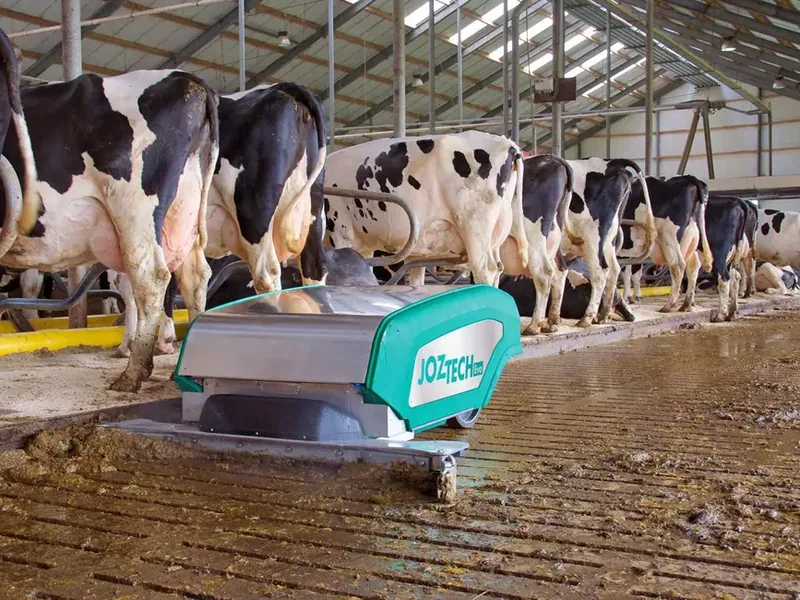
Manure and bedding robots are small vehicles. They drive a set route through the barn several times a day, then go back to their charging station.
Washing robots work in a different way. They go into empty pens or houses between batches of animals and spray floors and walls with high-pressure water.
Our catalogue lists 31 robots from 20 makers. 25 of them are on sale now.
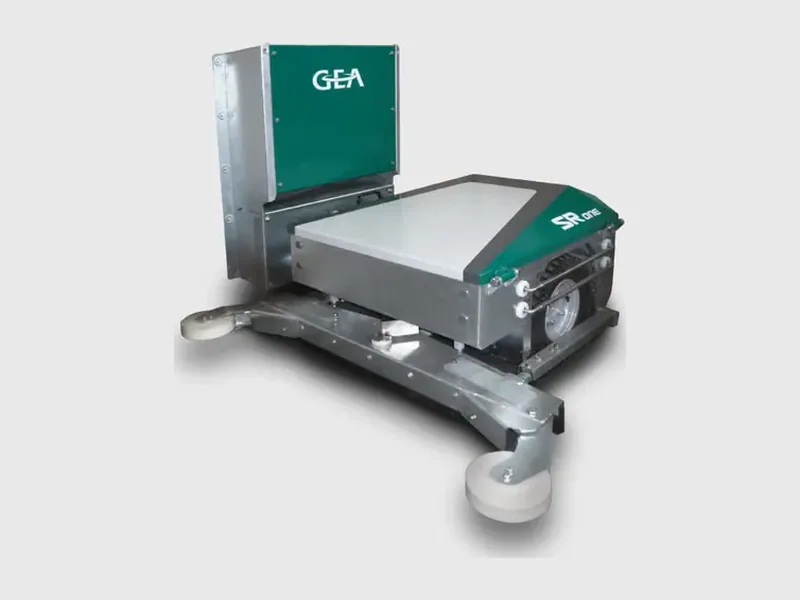
SRone
Scraper robot that cleans slatted floors in barns, traversing passageways, corners and edges to remove slurry.
Quote on request
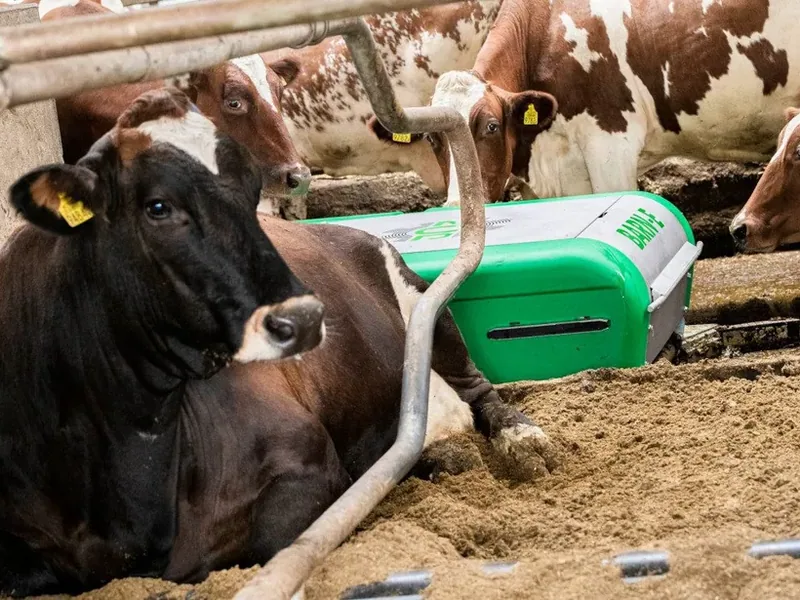
JOZ Barn-E / Barn-E PRO
Manure robot for solid floors
From €39,662
How much they cost
No maker in this group publishes a price, so you must ask for a quote.
2 of the 31 robots in our catalogue have a published price. Every maker gives the price on request.
The price depends on your barn: the floor, the length of the routes and how many robots you need. So ask the dealer to visit your site before giving a quote.
Ask what the quote includes. Compare these points between offers:
- Installation and the charging or docking station
- Route markers in the floor, if the robot needs them
- Service contract and wear parts, such as scraper blades or rubber lips
- Training for you and your staff
The main kinds of robot
Choose the kind by the job: push manure, suck it up, spread bedding, treat litter or wash.
The robots in this group fall into a few clear kinds. Most farms start with one of them.
Manure scrapers
A scraper pushes manure along the floor with a blade or rubber lip. On slatted floors it pushes the manure down through the gaps.
Some models have an optional water spray to wet the floor so the manure moves more easily.
Vacuum collectors
A vacuum robot sucks manure into a tank inside the robot. When the tank is full, it drives to a dump point and empties it.
This kind suits solid floors, where manure cannot fall through gaps.
Bedding and litter robots
Bedding robots carry straw or other bedding and spread it into the cubicles several times a day. Cubicles are the stalls where cows lie down.
In poultry houses, litter robots drive over the floor and break up caked litter. Litter is the bedding layer on the floor; caked means hard and crusted.
Washing robots
Washing robots clean empty pig pens, broiler houses or poultry aviaries with high-pressure water. An aviary is a house with several levels of perches and nests for laying hens.
Some also soak the surfaces first and spray disinfectant after washing.
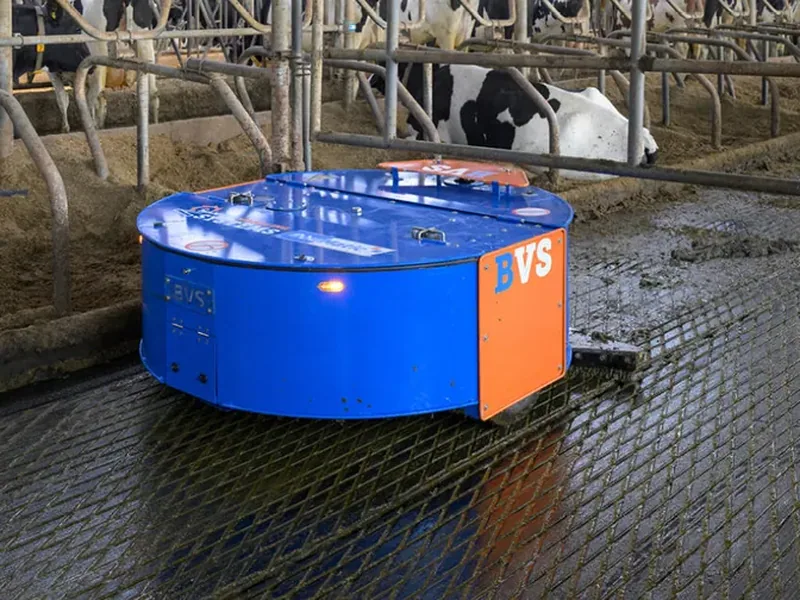
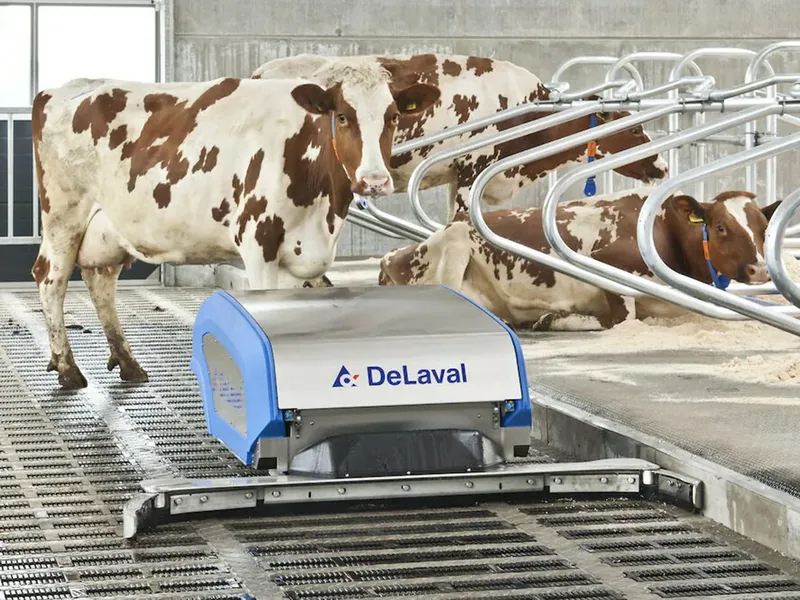
BVS BouMatic Vacuum Scraper
Fully automatic vacuum manure-cleaning robot
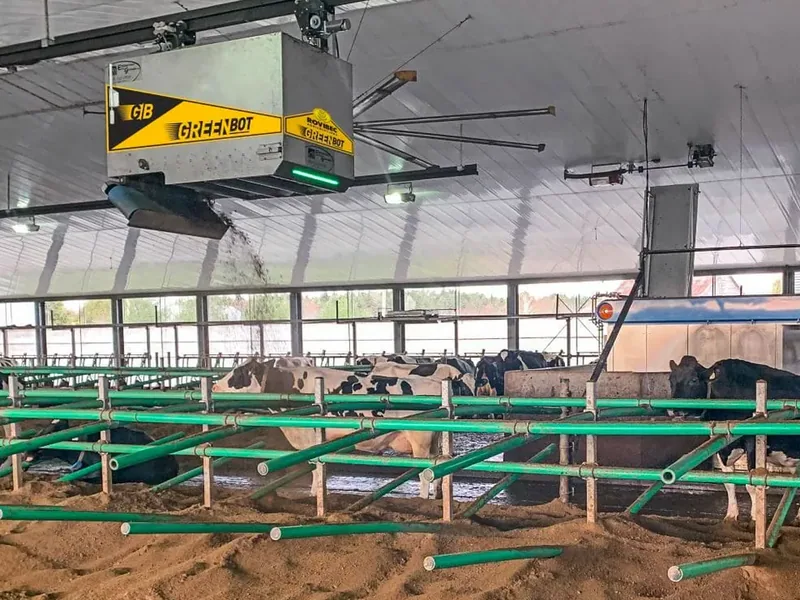
GreenBot
Intelligent robot that automatically distributes bedding into cubicles for livestock comfort.
Match the robot to your floor
Check first if your floor is slatted or solid; most robots are made for one or the other.
A slatted floor has gaps, so manure can fall through into a pit below. A solid floor has no gaps, so manure must be pushed to a channel or collected.
Scrapers are often made for slatted floors. Vacuum collectors are often made for solid or semi-closed floors, which have only a few small openings.
Some makers sell different models for different floors. Tell the dealer exactly what floor you have in each part of the barn.
Also check the slope of the floor. One bedding robot in our catalogue lists a maximum gradient of 5%.
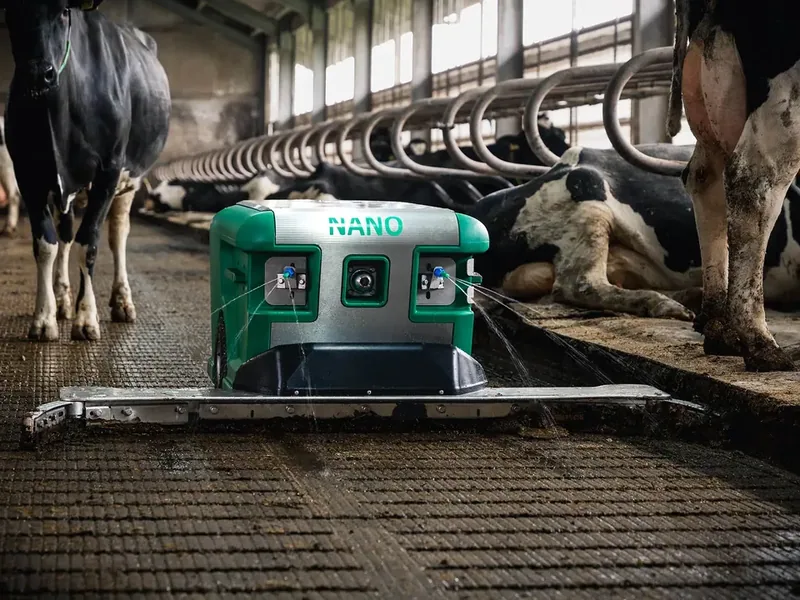
JOZ Nano
Compact manure robot for slatted and semi-closed floors
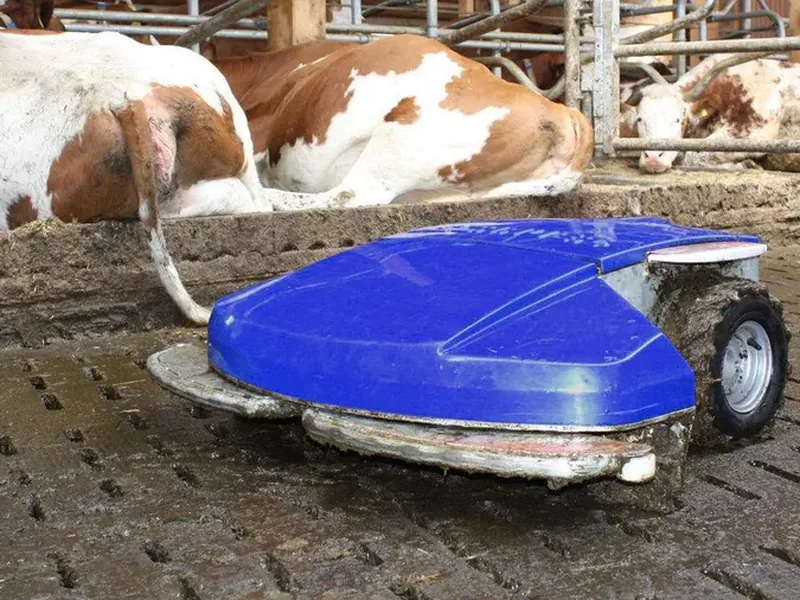
Manuro
Autonomous wireless manure removal robot that cleans slatted floors in dairy barns, including areas between…
How to size it for your barn
Count your animals and measure your routes, then check what one robot can clean per charge or per tank.
Makers often give the size of barn one robot can handle. For example, one vacuum robot is made for barns with up to 70 cows, and another comes in two sizes for about 80 cows and about 120 cows.
Check the working width too. In our catalogue, blade widths go from 120 cm to 1.8 m. A wider blade cleans more floor in one pass, but needs wide enough alleys.
For vacuum robots, check the tank size. One collector in the catalogue holds 450 liters of manure, another 300 liters. A smaller tank means more trips to the dump point.
Look at the height as well, so the robot can pass under gates, feed fences and cubicle rails.
Lely Discovery Collector C1 / C2
Autonomous vacuum manure collector for solid barn floors
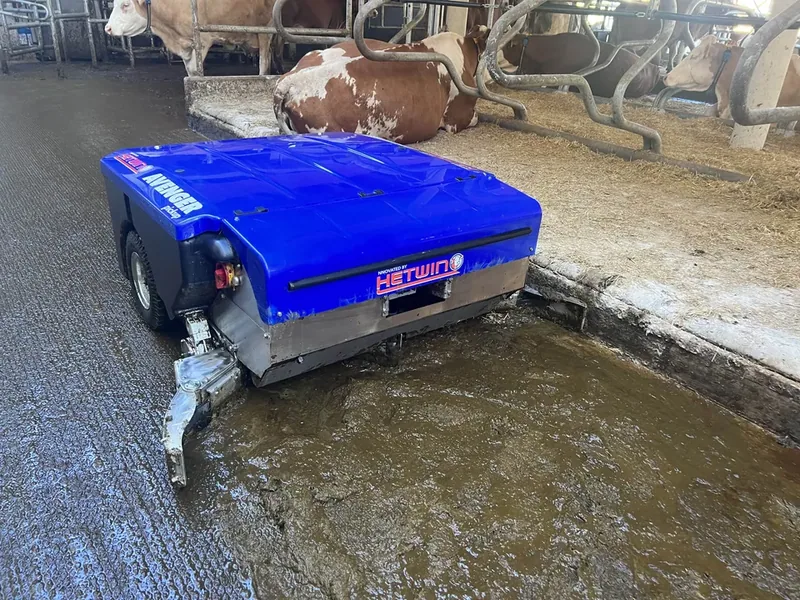
AVENGER PICKUP
Manure-collecting robot that keeps barn walking surfaces clean.
Washing robots: water, pressure and time
Ask how much water a washer uses and how long one house takes, because water and time are your running costs.
Water pressure is measured in bar. Higher pressure removes dirt faster but uses more power and can damage soft surfaces.
One pig-barn washer in our catalogue needs at least 25 L of water per minute. It has a maximum pressure of 200 bar and works at 140 bar.
Check that your water supply and power supply can deliver this. One washer in the catalogue needs a 230 V supply, which is normal mains power in many countries.
Ask how long the robot can work without stopping. One dual-arm washer lists a runtime of 20 h, so it can clean through the night.
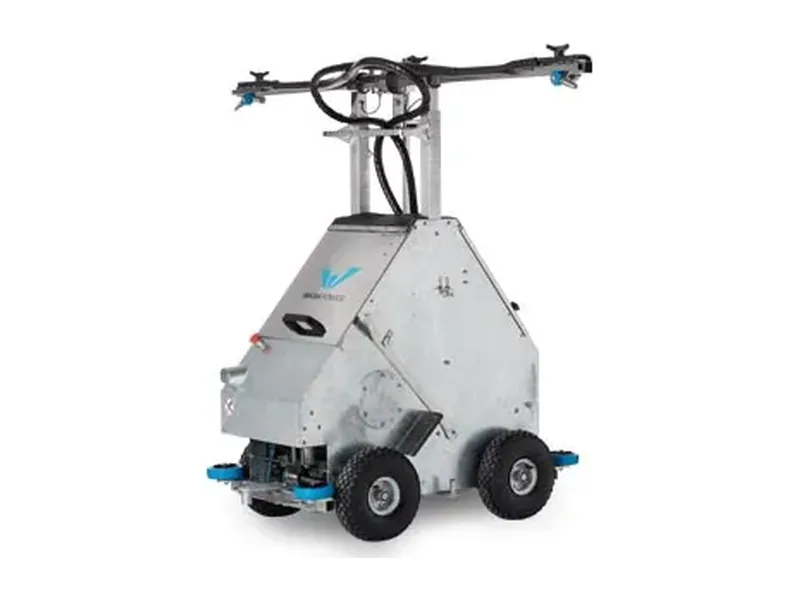
ProCleaner X150
Autonomous pressure-washing robot for pig houses with two movable washing arms
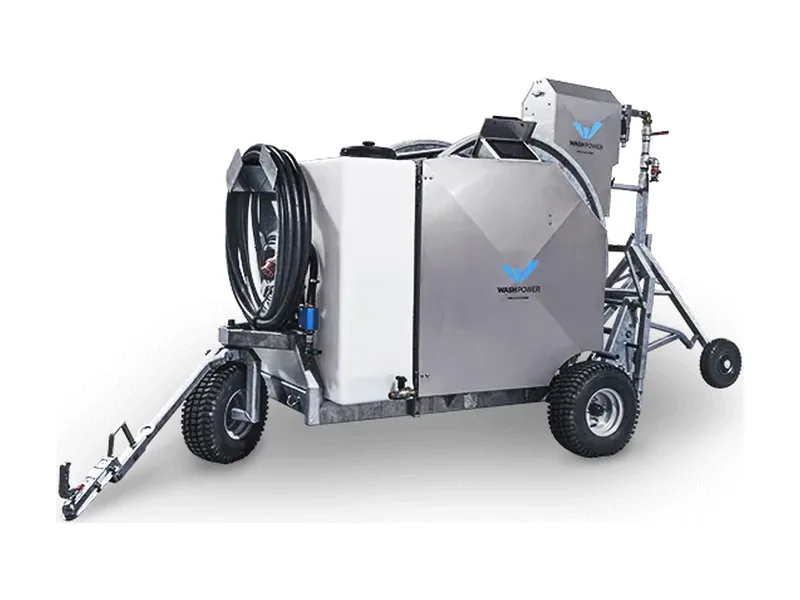
ProCleaner P200
Washing robot for broiler houses
Washing robots: do they pay off?
A washing robot pays off when someone washes by hand for many hours every week. Small rooms and few batches eat up the gain.
Today this job is done by a person with a pressure washer. It is slow, wet and loud work in dust and dirt, and few people want to do it.
How long it takes by hand: a German water permit counts 8 hours of work for one person per 500 finishing places. In Ireland, Teagasc measured 23.5 to 32 minutes for each farrowing pen.
A robot takes over the long, even part: floors and pen walls. A person still soaks the room first, moves the robot to the next aisle and washes troughs, feeders and corners by hand.
What makers say
Washpower says its robots cut hand washing by up to 80% in pig houses, and that the P200 takes over up to 50% of the heavy work in broiler houses. These are the makers’ own figures.
What tests and farmers found
- top agrar test (Germany, 2022): the Evo Cleaner washed a 10-place farrowing room in about 3 hours. The room was 80 to 90% clean, and rinsing by hand afterwards took about 15 minutes.
- German pig farm (top agrar, 2025): the robot washes a weaner room in about 1.5 hours, and washing work on the farm fell by more than half.
- Pipestone, a US sow farm (2024): washing one section fell from 5 hours to 4, with 1 person instead of 2 or 3.
- Murphy Family Ventures (US, 2023): the robot saves them 5 hours per wash and 22 hours a week. They went from 1 test robot to more than 30.
- Independent US test (SHIC and Pipestone, 2024): in a wean-to-finish barn, hand work fell by only 13% in one trial and 31% in the other. About 9 hours of hand washing were still needed per room, so the job took longer in total, and the robot used more water.
Work it out for your farm
More settings
A rough sum from your numbers, not advice. It leaves out interest, a pressure washer you may already have, water and grants. Ask the maker for a demo in your own rooms to find your real share.
Sources: Landkreis Cloppenburg, Teagasc 2022, Washpower 2026, top agrar 2025, top agrar 2022, top agrar 2025, Swineweb 2024, Swineweb 2023, Swine Health Information Center 2024
What farmers paid
Farmers in Germany paid about €35,000 to €40,000 for one washing robot.
Most makers still give prices only on request, so ask two or three for a quote with delivery, setup and training.
- A German sow farmer paid just under €35,000 for a Washpower robot. Service and repairs cost him €500 to €800 a year, mostly hoses and belts. He hopes it lasts ten years.
- A German pig farm paid €39,000 before VAT for a Schulze Bremer robot in 2024.
- top agrar put the Evo Cleaner at about €40,000 in 2022. In North America, a dealer sells it for about C$75,000 (US$55,525), with training and setup.
- One maker says its robot pays for itself if it runs at least 6 hours a week.
Sources: top agrar 2023, top agrar 2025, top agrar 2022, FARM SHOW Magazine 2025
Not only hours: dust, health and hygiene
When the robot washes, nobody has to stand in the spray for hours.
Pressure washing puts a lot of dust and endotoxin into the air. Endotoxin comes from bacteria and irritates the lungs. A US study measured some of the highest levels of any job during power washing of pig houses.
In a Swedish study, people who worked in a piggery after a robot had pre-cleaned it breathed in less dust and endotoxin and had less irritation in their airways.
Clean pens also matter for the animals. Teagasc found that better cleaning and disinfection of farrowing pens cut sick cases per litter by 86%, and piglets were 320 g heavier at weaning. A robot does not make that happen by itself, but it makes thorough washing every batch easier.
Sources: Annals of Occupational Hygiene 2012, Scand. J. of Work, Environment & Health 2009, Teagasc 2022
Where a washing robot does not fit well
Ask for a demo in your own rooms before you buy.
- Small rooms: moving the robot from room to room can eat the time it saves.
- Pen fittings: the robot does not see obstacles. One farmer had to change pens around feed and water lines, and a robot stops with a fault if fittings are not where it was set up to expect them.
- Soaking: it washes well only after the room has been soaked well. Some robots do not soak or disinfect by themselves.
- Feeders and troughs: these still need hand washing in most rooms.
- Water: in the independent US test the robot used more water than washing by hand.
Sources: top agrar 2023, Swine Health Information Center 2024, MS Schippers 2026
Similar robots, different jobs
Washing robots clean empty houses between batches. Manure and litter robots work every day while the animals are inside.
- Manure robots for pig barns, such as Schauer ENRO and TracVac, clean floors every day while the pigs are in the barn. They don’t wash.
- Poultry litter robots, such as Octopus and Birds Eye Robotics, turn and treat the litter on the floor of broiler houses. They don’t wash either.
- Washing robots, such as Washpower ProCleaner, Envirologic and MS Schippers, wash pens and houses when they are empty, before the next animals come in.
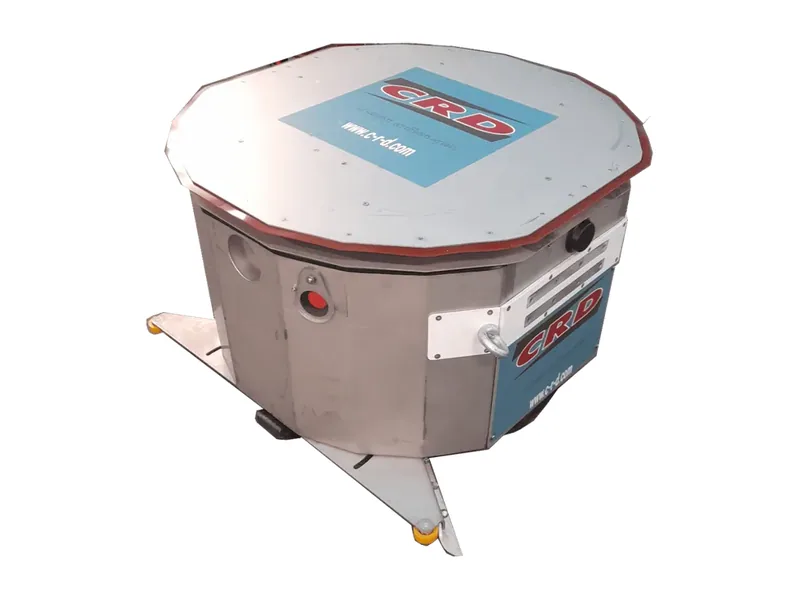
TracVac
Self-driving manure robot that runs under slatted floors and continuously vacuums manure out of the pit…
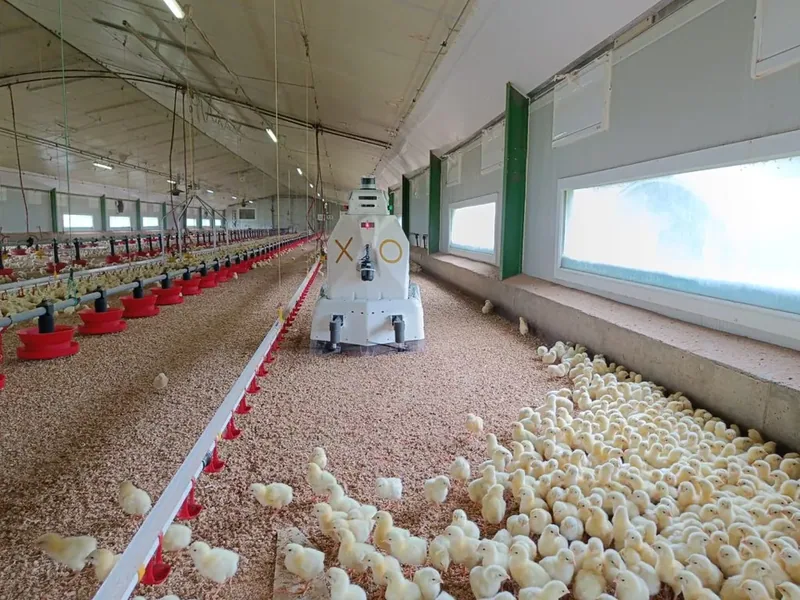
Octopus XO
Autonomous broiler-house robot for monitoring environment/animals and litter treatment; also picks up floor eggs
What to check before you buy
Check navigation, charging, safety around animals and local service before you sign.
Navigation is how the robot finds its way. Some read transponders, small tags set in the floor. Others use LiDAR, a laser scanner that measures distances, and need no floor tags.
With LiDAR or sensor navigation, you usually teach the route by driving it once, or set it in an app. Ask how easy it is to change a route when you rebuild the barn.
The robot works among animals, so ask how it stops or turns when an animal or a person is in the way. Many models detect obstacles and stop or steer around them.
Ask who services the robot near you and how fast they come. A broken manure robot means you must clean by hand again.
- Floor type it works on: slatted or solid
- Route length and area per charge
- Charging method and where the station goes
- Phone app and alarms when the robot gets stuck
Which one is for me?
- Dairy barn with slatted floors: Look for a manure scraper made for slats. Check the blade width against your alleys and ask how it cleans between cubicle rows. For example Lely Discovery Scraper.
- Dairy barn with solid floors: Look for a vacuum collector. Check how many cows one robot can handle, the tank size and where the dump point goes.
- Pig farm washing pens between batches: Look for a washing robot for pig pens. Ask about water use per minute, working pressure and how long one room takes. For example EVO Cleaner.
- Broiler grower: Look for a robot that treats litter during the flock and a washer for cleaning between flocks. Ask about the house size each one can handle. For example Octopus XO.
- Barn with straw-bedded cubicles: Look for a bedding robot. Check what bales it can load, how much it carries and the floor slope it can climb. For example Flypit.
Every barn is different, so compare several models side by side. Use the catalogue to filter the 31 robots by job, floor type and maker, then ask for quotes from those that fit.
See all 31 barn cleaning robots →
Where the numbers come from
- Landkreis Cloppenburg: Water permit: water and hours for washing pig houses (Farm advisers)
- Teagasc, 2022: Key hygiene issues: cleaning farrowing pens (Study)
- Washpower, 2026: Washing robots for pig houses (Maker's own figure)
- top agrar, 2025: Washpower ProCleaner P200 for broiler houses (Maker's own figure)
- top agrar, 2022: Kollege Roboter wäscht den Stall (Farm press)
- top agrar, 2025: So macht Stall waschen Spaß (Farm press)
- Swineweb, 2024: Pipestone looks to Washpower and Danish farmers to automate power washing (Farm press)
- Swineweb, 2023: Murphy farm saw the benefits of robotic power washing (A farmer, in the press)
- Swine Health Information Center, 2024: Robotic power washing in a wean-to-finish barn (Study)
- top agrar, 2023: Der Waschroboter entlastet meine Mitarbeiter (A farmer, in the press)
- FARM SHOW Magazine, 2025: Robotic barn washer (Dealer)
- Annals of Occupational Hygiene, 2012: Endotoxin exposure of swine workers during power washing (Study)
- Scand. J. of Work, Environment & Health, 2009: Robot pre-cleaning and airway inflammation in a piggery (Study)
- Teagasc, 2022: Impact of improved hygiene in farrowing accommodation (Study)
- MS Schippers, 2026: MS Smart Cleaning Robot (EuroTier award entry) (Maker's own figure)