Golf ball collection robot buyer’s guide
Robots that collect balls on driving ranges, all day, while golfers keep hitting.
What a ball picking robot does
The robot collects balls on the range all day, while golfers keep hitting.
A ball picking robot drives over your driving range and collects the balls that golfers have hit. It works on its own, so staff do not need to drive a picker cart.
The robot is battery powered. It pulls a ball-picker unit, which is a row of rolling discs that lift balls from the grass into a basket.
When the basket is full, the robot drives back to an unloading point and empties it. When the battery is low, it goes back to its charging station on its own.
Because it is small and slow, it can keep working while golfers are hitting. Balls go back to the dispenser faster, and staff have time for other jobs.
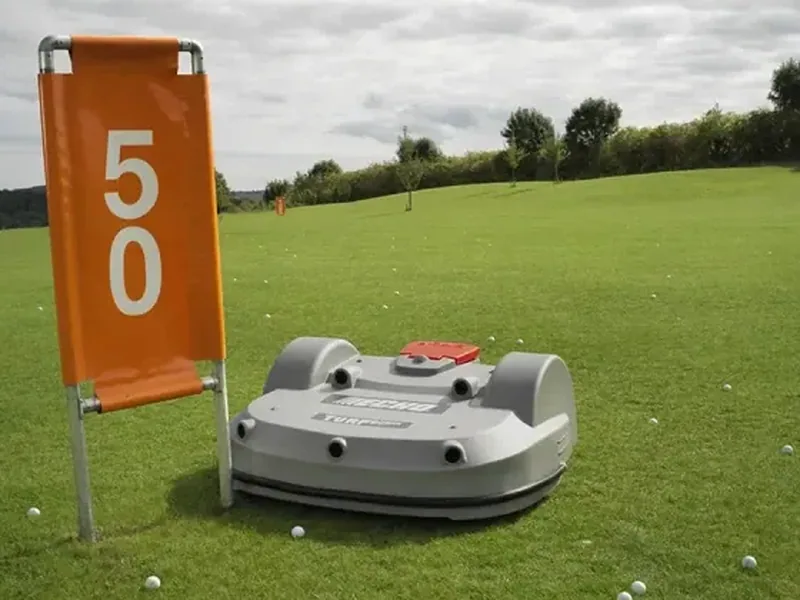
RP-1250 (golf ball picker)
Autonomous driving-range ball picker (equivalent to Belrobotics BP-1250)
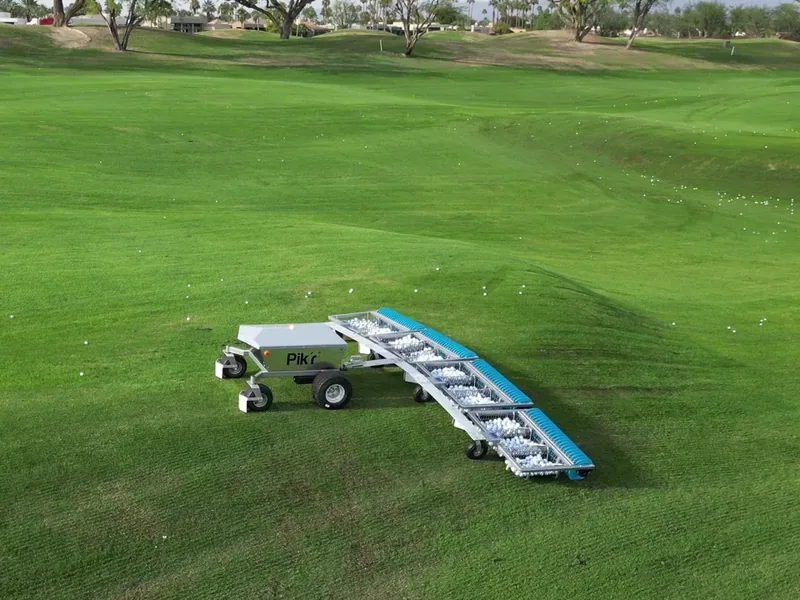
Pik'r-X / Pik'r-XL
Heavy-duty autonomous range-picking robots that collect balls on driving ranges.
How much it costs
2 of the 5 robots in our catalogue have a published price. For the others, plan to ask for quotes.
Our catalogue lists 5 robots from 5 makers. All of them are on sale now. Only two makers publish a price.
The Belrobotics BP-1250 starts from €22,990. The Tarracor Robotics TarraBot starts from €40,000.
For the other robots you must ask the maker or a dealer for a price. Ask what the price includes: the charging station, the picker unit, the GPS base station, installation and training.
Also ask about yearly costs, such as software subscriptions, service visits and spare parts like picker discs and batteries.
How they find their way
Precise satellite positioning and good obstacle sensors matter most.
These robots do not need a wire around the range. They use satellites and sensors to know where they are and what is in front of them.
GPS with RTK
GPS (or GNSS, the general name for all satellite positioning systems) tells the robot where it is. On its own, it is not precise enough to drive neat lanes.
RTK means a correction signal, usually from a fixed base station near the range. It makes the position accurate to a few centimetres, so the robot covers the range without gaps.
With GPS, you can also draw exclusion zones in an app. These are areas the robot must not enter, like bunkers, ponds or target greens.
Obstacle sensors
Sensors help the robot stop or turn around people, animals and objects. Some robots use sonars, which send out sound pulses and listen for the echo.
The Belrobotics BP-1250 lists 4 sonars. The TarraBot lists 360° obstacle detection, which means it watches in every direction.
How to size it for your range
Compare your busiest day’s balls and your range area with what the robot can do.
First count how many balls your golfers hit on a busy day. Then compare that with what the robot can collect.
Makers give their numbers in different ways. The Toro Range Pro 100 lists up to 19,500 balls a day. The Belrobotics BP-1250 lists up to 15,000 balls in 24 hours, with 300-350 balls per cycle (one trip from unloading point and back).
Next, check your range area. The BP-1250 lists ranges up to 45,000 m², the Range Pro 100 lists a maximum of 11.1 ac, and the TarraBot lists a work rate of 5 acres/hour.
Pick width also matters. This is how wide a strip the picker collects in one pass, for example 95.5 cm on the Range Pro 100. A wider pick width covers the range faster.
What to check before you buy
Look at hit protection, mowing, service and the GPS signal on your site.
Ask these questions for your own range before you sign.
- Hit protection: the robot will be hit by balls all day, so ask how the body and the driver area are protected.
- Robot mowers: the range grass also needs cutting. Check if the picker can work alongside robot mowers, and if they can share an app or base station.
- Signal and site: trees, tall nets and buildings can weaken the GPS signal. Steep slopes, wet ground and target structures can also cause problems.
- Service: ask where the nearest dealer is, how fast they can come, and if they keep spare parts.
Which one is for me?
- Small or medium driving range with a tight budget: Look for a published price, a simple app with exclusion zones, and a range area limit that fits your site. For example BP-1250 (golf ball picker).
- Large range with long opening hours: Look for a long runtime, a high work rate and fully automatic unloading and charging. Ask if one robot is enough on your busiest day. For example TarraBot.
- Range that already uses robot mowers: Check that the picker can work on the same range as your mowers, and ask if they can share an app or GPS base station.
- Busy city range with many hitting bays: Compare balls per day with your busiest day, and look at basket size and how fast the robot unloads. Strong hit protection matters here.
Compare all 5 golf ball collection robots in our catalogue to see their specs and prices side by side. Then ask two or three makers for a quote for your own range.