Poultry and animal care robots
Animal care & monitoring buyer’s guide
Robots that watch over animals: walking poultry houses, keeping birds active, collecting floor eggs, reporting dead birds and herding.
What these robots do
They move through animal houses, watch the animals and report problems, so you need fewer checking walks.
These robots watch over animals for you. Our catalogue lists 18 robots from 14 makers, and most of them work in poultry houses.
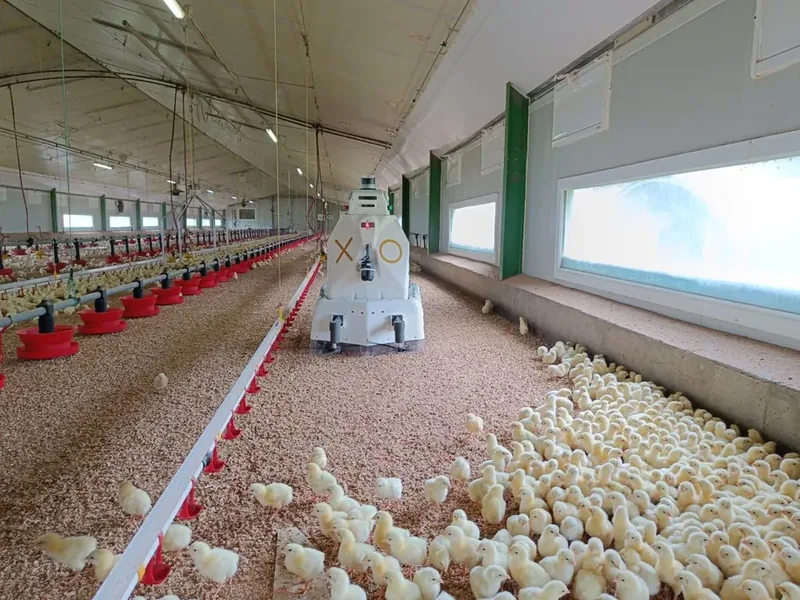
A floor robot drives slowly between the birds. It carries cameras and climate sensors (sensors that measure temperature, humidity, air quality and similar things).
Its regular passes also make the birds move. Active birds use the whole house, and breeder or layer hens lay more eggs in the nests instead of on the floor.
Some robots do extra jobs. They break up caked litter (the hard, wet crust on the bedding), pick up floor eggs or report dead birds.
The main kinds
Choose the kind by where it must move: on the floor, on a ceiling rail, or across a pasture.
The robots in this group work in different ways. The main difference is how they move and what they watch.
Floor robots
These drive on the litter on wheels or tracks. They make birds move, and many also report spills, leaks and dead birds.
Small models focus on getting hens to lay in the nests. Bigger ones also treat or break up the litter.
Ceiling robots on a rail
These hang from a rail under the roof and travel along it. They do not drive through the litter, so they do not push through the birds.
In poultry houses they measure climate, air quality and sound, and find dead birds. In pig houses, one rail robot takes 3D photos (photos that show depth) to estimate pig weight.
Self-moving barns and coops
These are small barns on wheels with solar panels. They move to fresh pasture on a schedule, with feed, water and ventilation on board.
Other animals and jobs
A few robots do other work: herding and pasture checking, scaring birds away from vineyards and orchards, or taking milk samples in a milking robot to check heats and pregnancy.
The herding robot in our catalogue is still a prototype (a test model, not for sale).
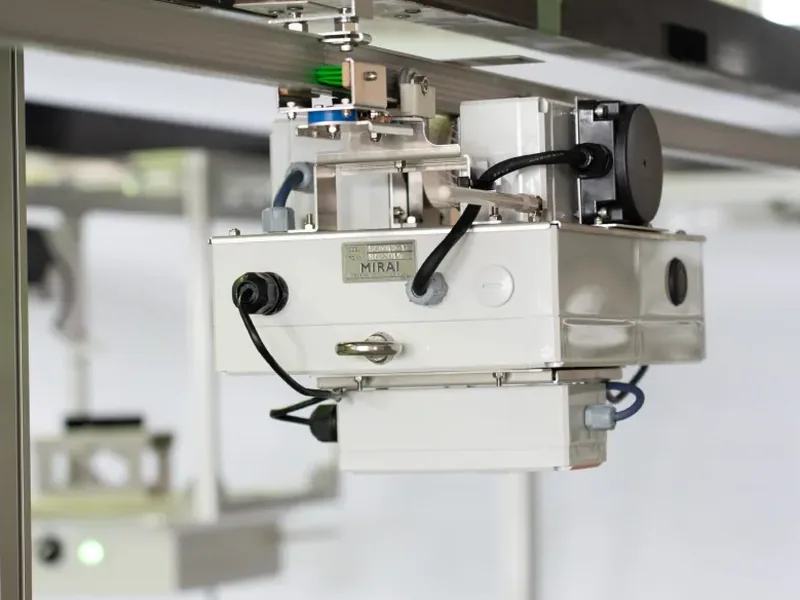
Pig Weight Measurement Camera Robot
Rail-mounted camera robot that travels along the pig-house ceiling taking 3D photos to estimate pig weight.
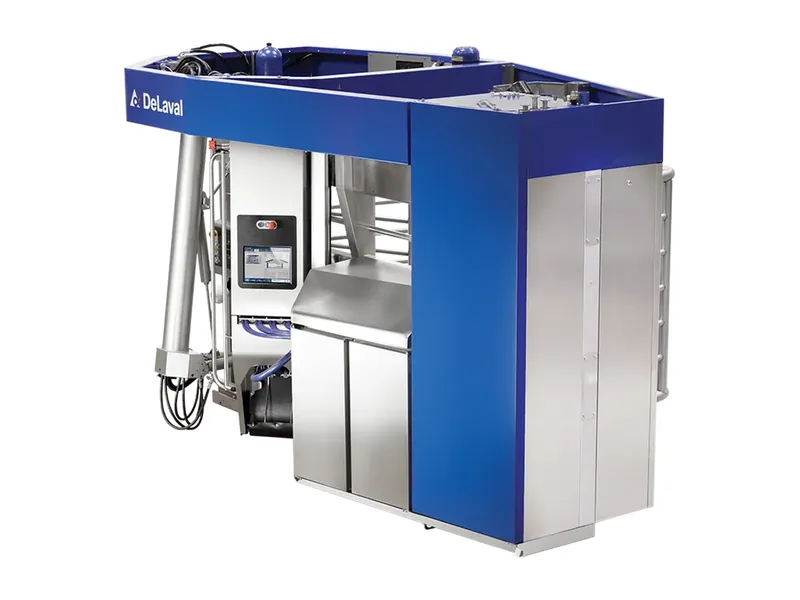
DeLaval VMS V310
VMS V300 plus RePro in-line progesterone sampling
How to size it for your farm
Match the robot to your house size, your flock and how long it runs between charges.
Start with the size of your houses and the number of animals. The robot must cover the whole house often enough to be useful.
Ask how long it runs on one charge and how long it takes to recharge. For example, makers list about 8 hours for the Birds Eye Caretaker, and about 10 hours for the T-Moov with up to 3 hours to recharge.
Ask about obstacles too. A floor robot must get past feeders, water lines and fences inside the house. The Caretaker’s maker says it handles houses of 40,000+ birds with these in place.
For self-moving barns, size means animals per unit. The ROVA|BARN Micro holds 8 to 12 laying hens; the ROVA|BARN 700 holds 526 broilers or 385 layers.
Price and availability
No maker publishes a price, so ask for a full quote and check that the model is really on sale.
Only 1 of the 18 robots in our catalogue has a published price. All makers give prices on request.
When you ask, get the full cost: the robot, the charging dock, installation and service. Ask whether software and reports are a one-time cost or a subscription (a regular fee).
12 of the 18 robots in our catalogue are on sale now. The others are at pre-order, pilot (tested on a few farms) or prototype stage, and one is discontinued (no longer made).
What to check before you buy
Check what it reports, how you clean it between flocks, and how alerts reach you.
Ask exactly what the robot detects and reports. Some report mainly climate; others also report dead birds, spills, leaks or where the birds are in the house.
Then check these points:
- Alerts: can it send alerts to your phone or into your farm system, and can you choose which ones?
- Biosecurity (keeping disease out): can you wash and disinfect it between flocks? A pressure-washable body makes this easier.
- Power and network: where does the dock go, what power does it need, and does it use a network cable, Wi-Fi or an app?
- Support: how long will the maker supply parts and software updates? Support for one older model in this group has already ended.
Which one is for me?
- Broiler grower with large houses: Look for full-house coverage, litter work and reports on dead birds. Check run time and how it gets past feeders and water lines. For example Octopus XO.
- Breeder or layer farm with floor eggs: Look for a small robot that keeps hens moving and runs long between charges. Ask how many passes it makes each day. For example T-Moov.
- Homestead with a few hens: A small self-moving coop with solar power, water and feed on board. Check how many hens it holds and whether your ground suits it. For example ROVA|BARN Micro.
- Pasture-raised poultry or pigs: A larger self-moving barn that moves to fresh grass. Check capacity, the movement app and live video. For example ROVA|BARN 700.
- Vineyard or orchard with bird damage: A driverless robot that patrols the rows and scares birds away. Check its navigation (GPS and camera) and what else it can carry. For example Avvy.
Compare all 18 animal care and monitoring robots in our catalogue by maker, stage and specs. Then ask the makers on your shortlist for a full quote.